JFL Banner
Dan French Workshop
SIC Web Center Ad

Comedy Isn’t Pretty – But It IS Pretty Tiring!

Last modified: June 30, 2010

For Comedians, Stamina Is a Virtue

A firsthand account of standing in line (in NYC) for Last Comic Standing Season 7

By Doug Hecox, Writer of Wrongs

NEW YORK CITY – March 22, 2010.  It is 6:25 a.m. and, despite eight hours of sleep, I am still tired. I don’t know how a City That Never Sleeps does it. I’m wiped.

Yesterday, I auditioned for NBC’s “Last Comic Standing,” a reality TV show pitting the nation’s best comedians against each other in weekly competitions which – like Fox’s “American Idol” – eventually allows the viewing audience to vote on who it thinks is funniest. Eventually, after weeks of winnowing down the field, one comedian is chosen as the “Last Comic Standing” and wins $250,000 and a development deal with the network.

Pretty exciting stuff, really, to the many comedians wanting to earn national recognition and to get some face time on national TV. Unlike previous seasons, which relied on casting calls in various locations across the country, this seventh season only had auditions in Los Angeles and New York City – the comedy capitals of each coast.

Some of the touring comedians in touch with the right people had pre-scheduled audition times, which is ideal for those whose schedules doesn’t permit spending the night waiting in line as hundreds of us did.

After getting up at 2:30 a.m. and readying myself for fame and fortune, I arrived at Gotham Comedy Club in Chelsea at 4 a.m. The auditions were to begin at 9, according to the material posted in various locations on the Web, and would continue until 6. The auditions were originally slated for the previous Sunday but schedule conflicts with this season’s host, the keyboard-playing comedian Craig Robinson, forced a weeklong postponement.

It is unclear how many comedians learned of the schedule change in time.

One thing should be said about New York at 4 a.m. — it is quiet, and there is virtually no traffic. It is a completely different city. The 150 comedians in line before me had been there for hours. One guy camped out on the sidewalk the previous Tuesday.

An Italian guy named Angelo had come to the U.S. the week before – and possibly didn’t get the word that they’d rescheduled the auditions. In any case, he spent the previous six days in a lawn chair near the club’s front door to be the first in line. That seems an excessive commitment of time, but such is the allure of national recognition on American television. Comedians wrapped in blankets, sleeping bags, and even a couple of tents decorated the front of the line. It was like a shanty town, only funnier.

The line-standing auditioneers were a motley crew – a rainbow of colors, ages and costumes. While most of the comedians in line were men, a few women were there too. One, a very slender 20-something, wore a tight sweater, vinyl boots and tight rock-and-roll pants like Rod Stewart wore in the 1970s. It was a look that anyone less attractive couldn’t have pulled off. The men, by comparison, were much more subdued. Many of the 20-somethings adopted hipster “indie” chic – mismatched suit jackets, rumpled corduroys or jeans, and bed-head. It seemed an unusual look to wear for one’s national TV debut, but each to his or her own.

I was dressed in what I thought would be appropriate TV wear – khakis, a white shirt and a royal blue sweater vest. My belief was that most of the other comedians would wear dark-colored casual wear – dark jeans, dark hoodies, dark jackets and so on – and I was right. Mine were the only khakis for miles and possibly the first sweater vest Chelsea had seen in decades.

As time wore on, more comedians showed up. Many had not been performing long but lived reasonably close by and decided to give it a try. I met a couple of guys in line – one, Kevin Hippolyte from Queens but who now lives and works in the Washington, D.C., area, and David Neufeld, an attorney from New Jersey. Brian, a big guy from Long Island with a New York Rangers hoodie and an easy laugh, said he’d tried out for the show a few years earlier. In retrospect, he confessed his earlier attempt was doomed to failure because in those days he was “wet behind the ears” as a comedian.

Spirits were high, and those in line – though cold – were optimistic. There was a sense of camaraderie that is unlike anything else. As I’ve learned over the years, comedians are very welcoming to other comedians. It’s a brothers-in-arms thing. We were all in this together, and probably all for the same reasons.

When the sun finally came out around 7 a.m., the line of shivering contestants had grown and started to wrap around the block. A deli that was open at 5 a.m. was doing brisk business from the many hungry, cold and thirsty comics. Some thoughtful person arranged four porta-potties to be available on the sidewalk for the legion of line-standing hopefuls. As uncomfortable as the wait was, it would have been much worse without such foresightedness.

By 9 a.m., a string of young people in jeans, jackets and headsets began asking the line to move back as, they explained, it was “too crowded” in the front. Translation: We need the line to look longer on TV. Also, a long thin line maximizes the contestants’ likelihood of being seen by the cameras. After several tries, the line moved back a little, spacing issues were resolved and we promptly resumed waiting. A producer walked the line, asking the comedians to sign paperwork allowing NBC to air their likeness on TV and so on. Most in the line had no pens. It’s funny what one forgets to pack when camping on the street in New York. I had a few pens, which I shared with some of my new colleagues.

Around 10 a.m., camera crews began shooting shots of the comedians in line. The producers wanted us to be “excited,” and to give them “lots of energy.” Translation: They wanted comedians to yell and scream enthusiastically like the auditioneers do on “American Idol,” ABC’s “Extreme Makeover: Home Edition” and other try-out shows – and so we screamed, yelled and applauded like seals for the cameras.

By 11 a.m., the show’s host – comedian Craig Robinson, from “The Office” and the soon-to-be-forgotten “Hot Tub Time Machine” – arrived and began walking the line, doing quick interviews with some of the comedians, and shooting the show’s opening montage. It will feature him playing his keyboard, singing a song he wrote for the show, followed by a bunch of comedians who will eventually erupt into applause and wild cheering. This took several tries and, by the sixth or seventh take, our enthusiasm was fading. The cheering crowd was losing its cheer as fatigue set in. Most of the crowd had been standing, sitting or sleeping on concrete for six hours by this time, and many even longer. Though we were ready to perform for the judges, many of us would’ve killed for a little heat. Though the 45-degree morning wasn’t too cold, standing in it for hours is a feat of endurance. It’s probably similar to what Guantanamo Bay is like on Christmas Eve.

Robinson cruised the line, bullhorn in hand and cameras in tow, talking with comedians, asking where they were from, and so on. Various producers and cameramen interviewed a guy dressed like a cowboy, complete with a western-style shirt that said “country music” on the back. They interviewed a guy dressed like an angry clown. They interviewed a guy from Pennsylvania who was a dead ringer for Howard Stern, complete with round sunglasses. They interviewed a loud 20-something chatterbox from Pittsburgh, complete with fauxhawk – presumably because he looked a little like Kanye West. He interrupted the “Howard Stern” interview, a la Kanye, to the delight of the producers. The cameras, clearly, were drawn to the fringe elements. I saw no one in a chicken suit but, had there been one, he, she or it would have been interviewed on camera. The most face time I got while standing in line was when the angry clown walked nearby, en route to hilariously berate some other comedic bystander.

At noon, the judges – comedians Andy Kindler, Greg Giraldo and Natasha Leggero – and many in the production crew took lunch. They are union workers after all. And, so the wait continued.

By 12:30 p.m., the line had begun to inch forward and, by 1:30, I was inside the club en route to my audition. Though each comedian was to do two minutes of material in front of the judges and the cameras, producers were screening out those who had no business being there. They wanted each performer to do 60 seconds’ worth of material, from which they would pass judgment about whether you deserved to move on to perform two minutes for the judges.

I was ushered into what appeared to be a storeroom, which had three office desks. It was a tight fit. At each desk was a producer, and I was invited to begin. After my little bit about Halloween costumes, almost exactly 60 seconds in length, the producers were laughing. One said “Ok, I think you’re funny. Congratulations” and gave me a little green slip of paper – they called it a “green card” – which I was asked to take to one of the other producers upstairs so I could wait before performing for the celebrity judges and the cameras. Most of my line-standing counterparts hadn’t earned a green card and were already gone.

By this time, it was 2 p.m. and I was beginning to fade. I hadn’t had anything to eat or drink that day – except for some Twizzlers I’d brought with me. I ate them around sun-up, so I was running out of steam. I found a chair, was given more paperwork to complete, and luxuriated in the fact that I wasn’t standing anymore. After hours of standing on concrete, my legs were stiff, my lower back hurt, and I was chilled. It took me a long time to get warm. I hadn’t appreciated a chair and indoor heating so much as I did at that moment.

As the hours wore on, more comedians came and went for their pre-scheduled auditions.  Michael Petit from Massachusetts. A blond deaf/mute comedian, and his interpreter. The musical combo Stuckey and Murray. A guy with a puppet shaped like a cartoon duck. A tall African-American man dressed in drag, calling himself “Kitty Withawhip.” Robert Burck, a.k.a. New York City’s famous “Naked Cowboy” – wearing a fur coat by the way, because even naked cowboys get cold. Truly, comedy comes in all shapes and sizes.

Down the hall, we could see the doors to the club’s showroom where we would perform. Periodically, comedians who had been invited back for a show with an actual audience – the “showcase” – were interviewed by the show’s host. A few others, who weren’t invited back, were given a brief “exit interview,” much like Ryan Seacrest does on Fox’s “American Idol.”

By 4:30 p.m. – more than 12 hours since I’d originally arrived – I was one of six comedians asked to follow a producer through the club’s kitchen to backstage, from where we would enter the showroom and do our thing. Of the six, I was the fourth to go on. Each performer was instructed to enter quickly to the stage, acknowledge the judges but look at the TV camera that was dead ahead of center stage. “Play to the camera,” we were told, “not to the judges.”

An older woman in our group, with what appeared to be tights, pumps and pink hair, went out and ranted. She had no jokes and wasn’t particularly funny. She rambled energetically about being a teacher and a prostitute, that amoebas produced lizards and that lizards produced monkeys. She was all over the map. Some producers in the basement thought SHE was funny? Well, as I later learned, probably not. Instead, she makes for good TV. Having a few wackos in the mix makes the show fun for the people at home who think all comedians are half-insane anyway. With the help of those producers, she helped perpetuate that fiction which was upsetting because she seemed fully insane to me. They had a hard time getting her to leave the stage, actually.

When it was my turn, I walked out quickly, and made sure not to trip on the step as I walked on stage. I grabbed the mike, and the judges said “Hi.” I said “Hi, I’m Doug Hecox” – waited a moment – and then launched into my two-minute set. I was enthusiastic, upbeat and articulate. After my brief two-minute set was done, Giraldo said “Doug, we’re over here!”

I’d been performing to the wrong camera.

The one I SHOULD have been performing for was exactly where they said it would be… but it was sort of in the shadows and there was another big camera on a crane, sort of in the middle of the room. I thought IT was the camera, but I was wrong. Natasha Leggero, feeling like it was an honest mistake, encouraged me to do one more joke for them to the correct camera… which I did. I did my Halloween bit, which had been such a hit with the basement producers only two hours earlier – but to no avail. I could faintly hear the sound of crickets chirping.

The judges said they liked my look – including my sweater vest – but that I wasn’t right for the show. I thanked them and exited stage right. I walked back upstairs, grabbed my coat and walked back out into the daylight – sort of glad, and sort of relieved. I needed food and rest, and not necessarily in that order.

Maybe I’ll try out again next year. For now, I found what I was looking for – a satisfied curiosity, a televised audition and possible screen time on the show.

Steve Martin once said “Comedy isn’t pretty,” and he’s half-right. Comedy isn’t pretty – but it is pretty tiring.

#    #    #

ADDENDUM – June 14, 2010:  During an evening layover at Dallas/Fort Worth International Airport en route to a show in Nebraska, I checked my email to see numerous messages from friends all over the country. Their messages were short but enthusiastic.

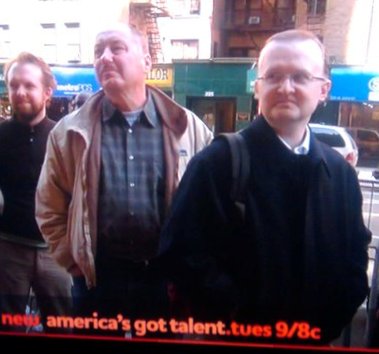
“Doug,” they wrote, “I just saw you on NBC!”  One guy, using Tivo, went back and found my split-second appearance, took a photo and emailed it to me.

Doug in NYC for LCS

All it took was a quarter-second appearance of me standing in line and looking like something smelled bad, to generate lots of exposure – truly, a testament to the power of national TV’s reach. It also explains why so many comedians are willing to put up with such adversity for the glimmer of a possibility of getting on the show. That’s show business.