Listen to the SHECKYmagazine Podcast!
- A YEAR LOCKED DOWNMr. Potato Head, Dr. Seuss, truth, common sense and trust have all succumbed to a totally different virus! Will history, art and "Breakfast At Tiffany's" be the next victims? Is that a light at the end of the tunnel, or is it the headlight of the Woke Express? Give us a listen and find out!
- Comedians Are Energy ConductorsIn Episode 18 of the SHECKYmagazine PODCAST, Brian and Traci vent about the 198-day (and counting) lockdown, flying, Sophie Tucker, ancient alien astronauts and ENERGY-- why we lack energy, why we need energy and how comedians are super-conductors. Tune in now-- but STAY AWAY from the CANS!
- Is It Over?Brian McKim & Traci Skene, podcasting from locked down Las Vegas, NV, consider whether standup comedy-- LIVE, the way it oughta be-- will ever come back from the Great 2020 Fear Porn Lockdown Pandemic Panic! Is life over? Is the career history? The future, as always, is uncertain. Listen in as we speak for the […]
The Authors

Shecky! Alumni!
Dan Rosenberg
…& Lester
Tim Cavanagh
Paul F. Tompkins
Mitch Hedberg
Mack Dryden
Jamie Alcroft
John Curtin
Joey Yanetty
Pete Fogel
Kip Addotta
Bob Zany
Wayne Cotter
Richard Lewis
Andy Kindler
Jimmy Myers
D J Hazard
Nehl Bobal
Sheila Kay
John Bizarre
Doug Benson
Jim Shubert
James Gregory
Gabe Abelson
Paul Gilmartin
Hal Sparks
Bob Harris
Paul Bond
Grover Silcox
Basile
Bobby Collins
John Wing
Brian Whalen
Rich Williams
Steve O.
Jeff Shaw
Ryan Wilner
Brad Slaight
Harland Williams
Joe Rogan
Triumph
David Feldman
Steve McGrew
Dan Barton
Rob Becker
Matt Weinhold
Bobby Gaylor
Steve Silberberg
Jeffrey Ross
Dave Little
Vince Vieceli
Marc Jaffe
Dick Cavett
Buddy Fitzpatrick
Stephen Kruiser
Suzy Soro
Jeff Allen
Doug Stanhope
Kid Dave Miller
Brian Kiley
Gary MuleDeer
Jim David
Judy Carter
Drew Hastings
Andrew Gropman
Rabbi Bob Alper
Dan French
Robert Hagearty
Chuck Savage
David John McCarthey
Mrs. John Hughes
Jason Stuart
Rick Overton
Steve Eblin
Jack Mayberry
Tom Parks
Charles Viracola
Rusty Warren
Robert Dubac
Jeff Marder
Joe Dunckel
Evan Davis
Veronica Mosey
Troy Conrad
Matt Davis
Mat Becker
Lewis Black
Dan Carlson
Jan McInnis
Joe Dixon
Larry Getlen
J.D. Sidley
Jeff Klinger
Tony Camin
Bill Engvall
Pat Mac
Anwar Richardson
Mary Ann Nichols
Rita Rudner
Larry “Bubbles” Brown
Jim Morris
Brett Butler
Kathleen Madigan
Todd Barry
Roger Ritenhouse
Marc Maron
Doug Hecox
Tommy James
Emo Philips
Lord Carrett
Jim Gaffigan
Eddie Gossling
Tom Rhodes
Etta May
Ron Zimmerman
Ross Bennett
Franklyn Ajaye
Chris Zito
Argus Hamilton
Costaki Economopoulos
Laurie Kilmartin
Jimmy Pardo
Leslie Thomason
Bill Bunker
Vinny Badabing
Henry Cho
Jonathan Katz
Dave Pavone
Larry-Bob Roberts
Brian Hennigan
Kenneth Nichols
Rich Vos
Dave Mordal
__________________
Traci Skene & Brian McKim

SHECKYmagazine
Editors, Publishers
© Copyright 1999-2022 SHECKYmagazine Published by Independent Together
“You can’t fix unfunny.
Vindication is sweet. And, in this business, rare. Hear our tale of vindication!
You may have heard of Bar Rescue, the Spike TV reality show in which host Jon Taffer and a camera crew descend on a restaurant or a karaoke bar or other similar venue and “rescue” it by re-arranging the furniture, changing the menu or otherwise dishing out tough love to the failing owners and managers. Taffer pulls no punches and, as you might expect, what he gets in return from the failing restaurateurs is rarely thanks but vitriol.
While chatting with some comedians in the green room of Laffs Comedy Cafe in Tucson, the conversation naturally turned to Phoenix– it’s close by (just 115 miles up the road)– and when the conversation turns to Phoenix, the subject of Standup Scottsdale will inevitably come up. We worked the room shortly after moving to Las Vegas, about two years ago last month. We privately cite that weekend as one of the most bizarre weekends we’ve ever experienced. And we cite the owner, Howard Hughes, as one of the least professional comedy club managers we’ve ever encountered.
We occasionally run across some folks who will corroborate our findings. Now, however, we have an entire episode of a reality show that, we hope, will quite clearly demonstrate just what we witnessed firsthand.
Bar Rescue attempted to save Standup Scottsdale! And the results air tomorrow (Sunday, April 14) night on Spike TV! Check your local listings for showtimes! (And if you can’t DVR it, you can wait a while and catch it on the Spike TV website (link above).
The teaser for the episode says, in bold letters, superimposed over a photo of the hapless Hughes onstage, “This guy doesn’t fear failure, he welcomes it.” Totally. Awesome.
The New York Post account of the finale (Yes, that’s right, it’s the season finale!) opens with the title of our posting and just gets better.
“A lot of people think that just laughter is the only emotion that’s appropriate for a comedy show,” Howard Hughes, one of the owners of Stand-Up Scottsdale tells the camera during the season finale of “Bar Rescue” on Spike. “I believe when you can get anger or sadness in there that those are the emotions that people leave with, and will ultimately bring them back.”
Apparently, Hughes also wants the comics to leave with anger and sadness. (Ultimately, however, it doesn’t really bring them back!)
There’s also an account in AZCentral.
We’re not sure if we’ll be able to catch the episode, but we’ll make sure we see it when it hits the Spike TV site.
The punchline to the story (according to our local sources) is that, immediately after the required 60-day period, Hughes removes all of the improvements Taffer makes to the exterior and also restores the interior layout to pre-Taffer specs. Why are we not surprised?
“Prove it.”
Some vacuous, insipid audience members have been piping up during shows with the above phrase. According to the urban dictionary, it’s a phrase that is calculated to annoy; an argument ender that is currently enjoying popularity among the particularly moronic. Well, that got that part right. In our experience, it’s a phrase that is used by stupid, shallow (usually female) teenagers… or frequently by adults who stil think and act like teenagers. It’s inserted quickly by an audience member– usually during a setup– and it has the effect of destroying a joke. We suggest to all club managers and bouncers that the offender be located and ejected– for a first offense. We comedians have weathered simlar storms in the past– “Not” (shouted after a punchline) was popular for a while. And the teeth-grindingly annoying “Yeah… that’s the ticket” was popular among trendoids who thought it was the height of humor to repeat that catchphrase after each punchline. Hey, assholes: If you want to get some comedy glory, get your brain-dead ass onstage at an open mike and do standup. If you lack the cajones, shut your fucking pieholes.
SHECKYmagazine.com’s 14th Anniversary!
We are quietly celebrating. It’s been fourteen years since we uploaded the first bits of content to SHECKYmagazine.com! Fourteen years!
Since writing our book and moving to Las Vegas, we’ve been focused on other matters and we’ve taken some time off from the magazine for days and weeks at a time. We aim to post more in the near future. We’re recharged!
Thanks to all of our readers over the years! We hope we’ve made a difference!
Scott Kennedy, standup comic
We woke up this morning to the news that Scott Kennedy passed away last night. We didn’t know Kennedy, but, judging from the testimonials on the social media, he was a beloved member of the standup community. Kennedy was most notable for having entertained U.S. troops in Iraq, Afghanistan and elsewhere, doing, by some estimates, as many as 60 tours over the last 12 years.
From U.S. Army Colonel John Rogers’ Facebook status update:
I awakened this morning to heartbreaking news… A great personal friend and a tremendous friend to the troops, Scott Kennedy, died in his sleep last night. A big, warm-hearted, exceptionally funny man who has dedicated much of the past 12 years to entertaining the troops in theater, Scott was loved and admired by all who knew him.
I am proud to have known you, my friend… Rest in peace. 🙁
Hal Spear, writer, comedian
We’re seeing chatter on the social media that Hal Spear has passed away.
We’re all too certain that it’s true.
We’ve known Hal since forever. The Male Half recalls a weekend in Atlantic City, when he was booked on a bill with Spear and John Ferentino. “We were booked at the Comedy Stop and we had decent lodging at a hotel near the casino,” recalls TMHOTS. “But Hal insisted on buying a hotel room down the street at one of the groovy, mid-century modern hotels on Atlantic Avenue so we could watch the most recent airing of Star Search, which Spear had recently taped. The three of us partied in the hotel room and watched the set on television. It was surreal. I was only in the business for a couple of years, but Spear gave off the vibe like he’d been in it for the past quarter century.”
Spear (real name “Hal Saperstein”) hailed from Merrick, NY, a town on Long Island’s south shore. He moved to Los Angeles during the early years of the comedy boom and occupied an apartment in Studio City with writing partners Lenny Travis and Dave Hawthorne.
“I visited their apartment on occasion,” recalls The Male Half. “They always seemed to be having the best time. They were up to their eyeballs in the Hollywood thing– writing scripts, bouncing ideas off each other, preparing to pitch projects. I envied them and their modus operandi.”
We frequently quote Spear around SHECKYmagazine HQ. We always impart one of Spear’s particularly interesting bits of advice to younger comics: “Always take the hotel room!” The larger implication is that we comics should always accept any and all perks offered, as refusing to do so might result in said perks being withdrawn down the line. It was sound advice then and sound advice now.
We hadn’t come across Spear in a long time. We know that he lived in Vegas, we heard that he moved here only recently. We made an attempt here and there to get together since our move, but it never happened.
Attention readers: A writing contest
From Tom Sebastian at Reach Entertainment, writing behalf of Will Smith and James Lassiter of Overbrook Entertainment and the ANA Alliance for Family Entertainment, comes this:
Here are some quick facts about the contest:
· It is being judged by Overbrook Entertainment, the award-winning entertainment production company co-founded by two-time Academy Award nominee Will Smith and acclaimed film producer James Lassiter
· Two winners will win $5,000, a meeting with Overbrook Entertainment, an opportunity to have their TV script further developed, and an 18-month option agreement on their script
· The contest submissions end on 3/21/13 by 1 p.m. PT and it’s free to enter
· The contest has two categories: a 30-minute comedy and a 1-hour dramaWe encourage you to visit the contest website here.
Or, take a look at a short video that explains the contest in more detail.
The last time a Jew was in this much hot water…
Here we go again. And again. And again. A comedian makes a joke. It offends some folks. People attack the comedian in the most vile ways (and by “people” we mean the media, advocacy groups and, most sickeningly, fellow comedians). And a mighty effort is made to shame the comedian and extract a meaningless apology.
We wrote about this last summer when Dane Cook was forced to issue a meaningless apology for making a joke about the Aurora theater shooting.
And that posting, which was entitled “Showtime at the Apology,” referred back to a posting that we had put up three years prior! So this nonsense has been going on for at least four years. And it’s been going on for longer than that. We said last summer that it’s getting “a little tiresome, defending our colleagues (against scurrilous comments often made by our colleagues!), but we can’t just let it slide. But it’s also getting tiresome watching our colleagues apologize.”
To save time and effort, read what we wrote seven months ago, but substitute “Joan Rivers” for “Dane Cook” and substitute “the holocaust” for “the Aurora shooting”:
Particularly nauseating are the comments on the websites– sites that cater to both the left and the right– which trash Cook, trash comedians in general, and fail miserably to understand that one of the functions of a comedian in our society is to say the unsayable, to give voice to our darkest or most uncharitable thoughts in the service of evoking laughter. We often fail in doing so, but we should be given wide latitude. Cook, by the way, did not fail in this case– the reaction to the joke was described thusly: “His comments regarding the shooting were met with groans that morphed into loud laughter and cheers.” (Daily Caller) Which is as it should be. Does anyone, for one nanosecond, think that the assembled comedy fans who laughed and cheered that night were doing so out of some sort of vulgar or wretched disrespect for the victims or survivors of the Aurora shooting? Can we explain their reaction in a way that allows for some coarseness but also recognizes a healthy catharsis? Are we not told that one way we deal with our darkest fears is by laughing at them? Is this not a case of dealing with fears by laughing? Is it too soon? Apparently, not. Not for the people who showed up at the Laugh Factory a week after the shooting. They were probably keenly aware of the misery and death in Aurora. And they might have been at a comedy club to blunt their fear or their pain. And, who knows– maybe they were subconsciously skittish about being packed into a theater one week after the worst mass shooting in American history. Their reaction might have been borne of that collective consciousness. It may have been that Cook addressed their long-term as well as their vague, immediate fears. We’re speculating, of course. But have you seen some of the speculation as to Cook’s motivation? Have you seen the comments that call him everything from an insensitive douchebag to a has-been to a homosexual? (Yes… that’s right– the comments from left, right and center employ the the “triumvirate of ultimate put-downs.” So far, no one has figured out how his comments were “racist.” Give them time.)
And we just noticed that, in our last few posts, we’ve spent a lot of time defending the people who laughed. That’s kind of important, as the people who laugh are the people who buy our product– live, recorded, televised, etc. It would be deadly if the folks who laugh are made to feel– through repeated tongue-lashings from perpetually offended busybodies– that their laughter is almost as egregious an offense as the “reprehensible” jokes being told by the “potty-mouth” comedians. We stand by them, just as we stand by the comedians who’ve come under fire. Who would you rather have in the audience? The folks who laugh at “inappropriate remarks” or the people who videotape them and seek to squeeze apologies out of the most successful comedians on the planet?
For those of you living under a rock, Rivers commented on a picture of Heidi Klum, on an episode of E!’s Fashion Police.
The last time a German looked this hot was when they were pushing Jews into the ovens
Without getting too deep in the weeds, we’ll start out by saying that the joke was either written poorly or delivered poorly. It should have been, “The last time a German was this hot…” But this is a minor flaw.
And though it has become tiresome, we probably would not have been moved to comment had we not turned on the television and seen a quote from Andy Dick who condemned Rivers’ joke and said further (and we’re paraphrasing) that perhaps some subjects are off-limits when it comes to comedy.
Let that sink in. Andy Dick said that some subjects are off-limits.
It gets worse. We were treated to a sickening lynch mob on Facebook that took off after Penn Jillette, who had the audacity to defend Rivers. Jillette was called all kinds of names– by fellow comedians and by civilians– and one comedian, Andy Kindler, tweeted the following:
Unpleasant blowhard Penn Jillette ignorantly defends the terrible comedy of Joan Rivers. No apologies says Donald Trump’s employee.
It’s official Andy Kindler has jumped the shark.
From the man who said that Dane Cook is worse than Hitler, “because at least Hitler had a point of view,” we are lectured on the “terrible comedy of Joan Rivers.” Kindler once said, “If slavery were legal, VH-1 would be South Carolina.” Doesn’t that trivialize the suffering of millions of Africans who were brought to this country in chains? We call upon Kindler to renounce these jokes. How dare he invoke the ugly episode that was slavery to make such a trivial point about the labor practices of a cable outlet.
Does Andy Kindler, of all people, really want to play this game?
No bigger fans of Kindler were we. We were present for nine or ten of his State of the Industry addresses at the Just For Laughs festival in Montreal over the years. But something’s changing. There were portents of this “evolution” (for lack of a better word). Like this, from our recap of Episode 01, Season 07 of NBC’s Last Comic Standing:
We’re puzzled as to why the show finds it so worthwhile to delve into Andy Kindler’s likes and dislikes when it comes to choice of material. We were upset when a print interview with Kindler quoted him as being disgruntled when it came to jokes about the homeless. He was “uncomfortable.” He doesn’t like it. He also said it on camera, on LCS.
This is not a good thing. We’re not sure why we’re treated to Kindler’s personal preferences when it comes to premises. Isn’t Kindler an Alt Comedy God? Are not the Alts noted for being free to choose what they joke about and how they go about it? Do they not represent a vanguard of free-thinking, daring and sometimes offensive performers who have thrown off the bonds that previously held back so many “conventional” comedians? It is more than ironic then that their patron saint be depicted as the Chief of the Premise Police… on a network television show.
And the fans don’t exactly agree with Kindler on this particular point. Indeed, one of the most tweeted and re-tweeted jokes from Episode One was Taylor Williamson‘s bit about the homeless still being able to own cats.
And was it Nikki Glaser who did the joke last night about the concept of love at first sight being the reason she can’t look a homeless person in the eye? Both great jokes. Both make light of the homeless.
Aside from it being somewhat upside down (and somewhat wrong) that a judge (particularly this judge) be so vehement about his dislike of a particular category of jokes, it then sets an odd tone and furthermore taints any enjoyment of jokes that might touch on that premise.
Witness the Jew Montage. Was there really a need for that? Depicting a group of comics as anti-Semitic merely because the happen to mention Jews? We’re puzzled as to why the producers would go out of their way to make a comic (or a group of comics) look bad because of a premise.
We’ve always been vehemently anti-Premise Police. Someone making a homeless joke– a clever joke that hinges on one participant or another being homeless– is doing nothing wrong. Thousands of jokes have been written that mention Jews and that weren’t automatically anti-Semitic. Indeed, Kindler himself has done it countless times. If a line is drawn arbitrarily and a whole topic is declared off-limits, we are poorer for it. We’re reminded of the comedy club or casino patron who bitches loudly to the club manager (or, in rare cases, to the comic himself) that he “doesn’t like it when the comedian makes jokes about (fill in the blank).” This person is usually regarded as a crank. And rightfully so.
We’re coming up on three years since that was written. (And actually three years almost to the day since the words were spoken by Kindler, since the show was taped in March of 2010.) We suspect, in that time, his views have hardened further. And hardened to the point where he is calling Penn Jillette “ignorant” and an “unpleasant blowhard” for daring to defend fellow comic Rivers.
From the CNN transcript of the Jillette interview on Piers Morgan Tonight:
MORGAN: Back now, my favorite atheist, although of course he can’t bring himself to actually believe that, Penn Jillette, author of “Every Day is an Atheist Holiday.” Let’s turn to this little fury building up over Joan Rivers.
So she made a joke about Heidi Klum in her post Oscars show. And she said this, “the last time a German looked this hot was when they were pushing Jews into the ovens.” Now the Anti-Defamation League’s response, as it has been to quite a few of Joan Rivers’ Holocaust jokes in the past, is that she should know better. “The remark is so vulgar and offensive to Jews and Holocaust survivors and indeed to all Americans.”
Joan Rivers has responded, doubling down, saying the reason she does this kind of joke is to keep the memory of what happened at the Holocaust — and many of her family members died in it — alive with people. Is that a good enough excuse?
JILLETTE: I don’t think she needs an excuse at all. First of all, Joan Rivers knows as much about comedy as anybody alive in the world.
MORGAN: That doesn’t give her a license to be —
JILLETTE: It does, it really does.
MORGAN: Heidi Klum, though, has every right to feel offended by her statement. Is that acceptable?
JILLETTE: You have every right to be offended by it. But she will not and should not apologize. I felt that when “The Onion” did their apology, they actually made it worse, because they took it out of the realm of joke and into something that maybe they could have —
MORGAN: Quvenzhane Wallis (ph), the little nine-year-old. I thought that was completely unacceptable and very, very offensive.
JILLETTE: Absolutely. But when you are doing transgressive humor, when you are trying — when the idea is to be shocking, when the idea is to get a laugh from something that’s outside of the realm of what someone else would say, when that’s your position, that is clearly her job. Her job is to cross certain lines so we all get to think about it.
MORGAN: No limits?
JILLETTE: I think there are limits to each one of us and our tastes and what we will enjoy. But as a society, I think blaming her or — and this whole idea that people are supposed to apologize for jokes seems out of line. It’s not funny. That’s fine. But she is not in any way, shape, or form condoning the Holocaust. To even —
MORGAN: I agree with that. I think the only person who probably should feel rightly offended is Heidi Klum, who had absolutely no reason to be linked to what Germans and Nazis did during the war.
JILLETTE: The joke is actually backwards from what the Anti Defamation League is claiming. It’s actually a joke against Germans. And the Germans might very well want to say, can’t we even have a hot model without that being brought up. She had nothing to do with that. So they are kind of, again, on the wrong side.
But I just don’t know how I can support Joan Rivers more. I mean, I just think that it’s absolutely OK to try anything in comedy. And it’s also OK for people to rise up and argue about that. But she does not need to apologize.
MORGAN: Let’s take a look at the all-star “Celebrity Apprentice,” which premiers this Sunday, March the 3rd. You’re in this.
JILLETTE: I am.
MORGAN: And the reason I know that is I’m in the premier episode.
JILLETTE: But you’re on the other side of the desk.
MORGAN: I went back on Donald Trump’s boardroom side, and I reengage with my old friend Omarosa, which I can only assure people is extremely entertaining. I went back with one objective, to get her fired. And I’ll leave it hanging in the air, but I left a happy boy. I go back into several episodes, actually.
But we’ve got this extraordinary situation where one of your colleagues in it, Dennis Rodman, is currently in North Korea telling everyone that Kim Jong-Un, the supreme leader, is now his best mate. What on Earth is Dennis up to?
JILLETTE: Isn’t that the most beautiful thing in the world?
MORGAN: Not really. Does he know what he’s doing?
JILLETTE: It absolutely is. You know, we’re talking about what really is going to bring people together. The first thing is always going to be — is Elvis. Elvis wins every battle. We have cool. We have rock and roll.
MORGAN: These pictures are just too ridiculous.
JILLETTE: And you’ve got a fan of basketball who’s over in this horrible country, treating their people terribly, nuclear stuff, and they’ve got Dennis Rodman, a good old American, who is over there doing great stuff.
MORGAN: We’ll agree to disagree on that. You’re getting a star on the Hollywood Walk of Fame on April 5th.
JILLETTE: Yes.
MORGAN: It’s great to see you again.
JILLETTE: Wonderful to see you, Piers. Thank you.
MORGAN: We’ll be right back.
We re-read Jillette’s comments and we failed to find any evidence of ignorance. We suspect that the only reason that Kindler has labeled Jillette a “blowhard” is because Jillette holds a (clearly) well-thought out and valid opinion that doesn’t quite match up with his own. We here at SHECKYmagazine.com often call people names when we disagree with them. It’s part of our charm over the past 13 years and 11 months. But we follow that up with a logical (and frequently passionate) defense of our position and a passionate (and occasionally logical) flaying of the other guy’s position. We know it’s difficult to do that within the 140-character confines of a tweet. But we can’t seem to find any kind of long-form rebuttal to Jillette’s opinion. Either by Kindler or by anyone else.
But all this hectoring of comedians is troubling. And we normally wouldn’t pounce so hard on Kindler had he not been so vicious when attacking Jillette. And had we not had the creeping, sinking feeling that Kindler represents a more widespread and (dare we say it) dangerous tendency on the part of so many to declaw comedy and try to declare wide swaths of subject matter off-limits. That kind of thinking and speaking is poisonous to comedy and death to the creative process. Of all the arts, of all the forms of creative expression, comedy is the one that is most susceptible to such proscriptions. It’s supposed to be out there on the edge, pushing the limits. If you blunt that edge, you tinker with the fundamental function of comedy.
For the longest while, we comics became a little too comfortable with the notion (that hardened into a dictum, a truth a principle) that only members of a group were entitled to joke about members of that group or their travails or foibles. “I’m black, so I can say that about a brother.” And it’s corollary: “You’re white, so you can’t do humor about black people.” This is in itself, stifling, arbitrary and a symptom of the disease that is political correctness. Now we’ve reached a point where an elderly Jewish comedienne can’t make jokes about the Holocaust. This cannot lead anywhere good.
Zany biopic available
Click on closebutnocigarmovie.com to purchase the delightful Bob Zany biopic and the Zany special (the making of which was depicted in the biopic). It’s a fascinating look a the career of a comic. Zany surveys his life in comedy with — surprise! — a sense of humor, and the footage of his appearance is priceless! (We won’t spoil it!)
Female Half puts in time @ the Factory
 The Female Half of the Staff had the pleasure of sharing the bill for the past week at LV’s Laugh Factory with Rich Hall and Harris Peet. And it was her good fortune to share some laughs in the green room with George Wallace (see above) on Saturday night. The Factory will soon be the LV home of Roseanne Barr (she’s using that version of her name on all the billboards, marquees and advertising), starting her Factory residency tonight with a 7 PM show.
A conversation between two morons
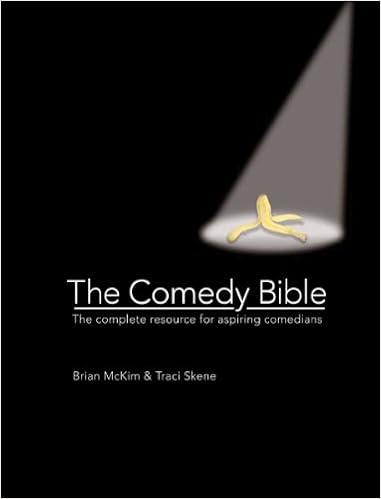
Writing about hecklers is nothing new. And attempting to group them into types is something that The Female Half of the Staff did in a column, “Heckler Alert,” nearly a decade ago. (And that column made it into our book, “The Comedy Bible: The Complete Resource for Aspiring Comedians,” and forms the bulk of our eight-page breakdown of hecklers on pages 102-109.)
We took a practical, pragmatic approach in explaining heckling and hecklers. We knew that heckling was something that happened (though not as frequently as some believe) and that if the comedian understood the motivation behind most heckling, he/she could better deal with it.
One thing we didn’t do was venerate the heckler.
Which brings us to “A field guide to hecklers,” a chirpy, vacuous and ultimately worthless back-and-forth from the Chicago Tribune’s Nina Metz and Chris Borrelli in which they “see if there might be a valid argument on behalf of those of us who are (gasp!) in favor of heckling.”
You read that right. They allow for the idea that there might be a valid argument in favor of heckling. Jacques Deridda’s work is done. We now have what we assume to be two college-educated 20-somethings– writing for a newspaper that has been in some sort of bankruptcy hell since 2008– and their idea of a provocative and entertaining article is to speculate on whether or not interrupting a performance by a professional entertainer might be something that has merit.
As Metz explains it, heckling– for an audience member– “works as a litmus test.” Huh? She elaborates: “The comic who turns hostile isn’t working at the top of their game. (And, we daresay, the journalist who cranks out that sentence isn’t working at the top of her game, either.) As proof, Michael Richards’ infamous Laugh Factory outburst is cited. Yawn. She continues: “But if they can zing back with a really sharp retort– but funny, it has to be funny!– they have my respect for life.”
Which is just what we want– the lifelong respect of this total idiot.
Metz continues:
My favorite flavor of heckler, though, is what I call the Productive Heckler, who’s there to keep the comedian honest. Last summer, during the Just for Laughs festival, I caught a show from Chris D’Elia, who co-stars on the NBC sitcom “Whitney.” D’Elia likes to do crowd work, which makes him even more susceptible to those with heckling tendencies. (Actually, it makes him less susceptible! But we don’t have the time to go into Comedy 101. — Editors) He began a joke with this setup: “Why is it so hard to get girls?” This from a good-looking guy on a TV show. All I could think was, “Yeah, right, you have trouble scoring attention.” And, happily, an audience member (female, though does that matter?) voiced the same thought with a one-word response: “Bull—-.” The audience kept D’Elia honest. He was forced to stop and explain why, even for a guy in his semifamous position, it’s not easy to meet noncelebrity-obsessed women. I love Productive Hecklers.
You know what, Nina Metz? Fuck you. And fuck your “favorite flavor of heckler.” And, while we’re at it, fuck your stupid fucking concept of “keep(ing) the comedian honest.” It’s not up to you or some asshole in the audience to keep the comedian honest. It’s not up to you or your favorite flavor of douchebag to keep anything honest. You pay your money, you watch the show, you laugh or you don’t. You stay or you go. Calling bullshit during the performance doesn’t keep the comic honest. It disrupts the show and it’s stupid and rude.
Nitwit # 2 chimes in:
It also sounds like a genuinely interesting moment of revelation, albeit one that was forced on the entertainer. We are now listening to someone say something they genuinely hadn’t intended.
The tsunami of dumb in those two sentences threatens to cause an immense amount of intellectual damage.
Musicians are viewed as artists with integrity who “don’t take requests.” When a musician states that as his policy, we are generally sympathetic and we understand that he has an agenda (called a set list) and that it’s up to him to take us on the trip he has planned. Why are comedians viewed as puppets that audience members can manipulate? Why, when an audience member attempts such manipulation, is it viewed as “a genuine moment of revelation?”
What arrogance!
We hate to sound like Grandpa and Grandma Comedy, but these two are self-centered, perpetually immature goofs who think that the world revolves around them. And that we are there to serve them. It’s all about Nina and Chris and they have a much better idea about how Chris D’Elia and Zach Galafianakis and the rest of us should respond when some equally narcissistic asshat ejaculates in the middle of one of our well-crafted sets.
Borrelli says:
On the other hand, as someone who wants an event to be memorable, yes, I’m pro-heckling. Who isn’t? I have seen countless comedians and forgotten most of them. But I remember each and every time I have witnessed a performer get into it with an obnoxious audience.
We remember shows where we have gotten heckled. And, we suppose, some audience members remember a show where there was an interesting exchange between a performer and a patron. But we mainly like to remember shows where we smoothly and precisely maneuver through a set and we remember the feeling of competently manipulating an audience into the exact state we want them to be in throughout the entirety of a 50-minute set. And we are certain that those audiences were aware that they were witnessing comedy at its finest and that they recall those performances fondly. Only a boorish egotist like this would encourage boorish behavior so that he might have a “memorable” experience.
When a couple of feeble-minded pop-culture magpies at a major, big-city daily even hint that heckling might, in some instances, be “comedy helper,” we cringe.
Says Metz:
As journalists and critics, we’re trained to stand and back observe (sic), so I don’t think it’s ever occurred to me to heckle. But I am always secretly thrilled (and nervous!) when someone else does it.
So, what we have here is someone who hides behind her supposed ethics when explaining why she doesn’t dare heckle… but who is “thrilled” when someone else does the heckling for her. She’s an odious combination of a coward on a power trip. “All right, everyone– *Clap-clap*– do my bidding! Heckler– spice things up a bit, as they are in need of some sort of edge! Comedy Boy– Respond in an edgy fashion, so that my boredom does not overtake me! You there, eunuch– bring me my goblet!” Get a load of Caligula over here!
What is wildly amusing about Metz’ orgasm over the “Productive Heckler” who “keeps the comedian honest,” is that half (if not more) of those honest moments she’s witnessed were probably just as contrived and locked down as the rest of that evening’s set. (She probably thinks that her favorite comedians who “riff off the top of their heads and bring us on an intoxicating, exhilarating improvisational ride,” are probably about as spontaneous as the flight attendant explaining the safety procedures of the Boeing 757-300 series aircraft. She probably thinks that reality television is “real.”) We hate to burst your bubble, Nina, but most of us have been at this comedy thing for so long that nothing surprises us. Not only that, but the “Productive Heckler” rarely ever says anything we haven’t heard before. We remember such putdowns and we save them in a file (real or virtual) so that we might use them again. (And, believe us, it will happen again– audience members are about as imaginative as big-city journalists.) So those “interesting moments of revelation” are most likely recreations of similar incidents that happened weeks or months or years before. (We just happen to be able to make it look spontaneous… and simpletons like Nina and Chris fall for it.)
On page 109 of our book, under the heading of “Common denominator,” we say:
Some hecklers may be hard to identify or categorize. But there is undoubtedly one thing they have in common. After the show, they will come up to you and say, “I helped the show!” No… you did not.
This article is nothing more than a pre-emptive version of the inebriated hosebag who comes up to the comic after the show and proudly seeks approval for his sparkling contribution to the evening’s proceedings. We have to break it to you, kids– you did not help the show.
Guest Set-iquette
In a perfect world, permission for a guest set would be granted by the headliner. It would be up to him or her if it would be all right if someone did five or six or eight minutes at or near the beginning of the show. But it usually goes down thusly: The headliner arrives at the venue, takes a seat in the green room and, minutes later, the club manager pokes his head in the door and says, “We got a guest set.”
Oh… okay.
No big deal, we suppose.
But more and more often, we cringe when we hear that there’s going to be a guest set on that night’s bill. In the past, it was no big deal. In the past, the pleasant guest set experiences outnumbered the unpleasant ones. But, in the last ten years or so, the guest sets have been leaving a bad taste. The reasons are many and varied. But there does seem to be a definite downward trend in not so much the quality of the guest sets we’ve followed, but the manners, the attitude and the gratitude.
We’ve examined whether it’s our attitude that’s changed. We’ve come to the conclusion that it’s not us… it’s them.
Herewith, our examination of the guest set. With tips (“Guest Set-iquette!”) on how to handle them. We hope folks take the advice. We can always hope.
The Audition Guest Set
Has anyone ever gotten a headline spot out of a five-minute guest set? We suppose it’s happened. But it’s rare. (You’re most likely auditioning for a spot as a feature or as a host/emcee.) So… don’t act like you’re taping your HBO special. Be competent, be funny. Don’t go up there and try to “blow the headliner off the stage.” You’ll have plenty of time to prove yourself if/when you get a gig. Until then, you’re part of a larger show. You are… a guest.
You might ask, “But how am I going to prove that I’m a hotshit standup comedy monster if I don’t go up there and crush, kill destroy?” Don’t worry, Pancho– the club manager probably isn’t even watching. And if he is (and he’s an astute observer of standup comedy, by which we mean that he’s utterly bored by watching guest sets and he wants to gouge his eyes out whenever anyone does a guest set), he’ll be able to recognize within about 20 seconds whether or not you are: A headliner, a feature act, an opener or an opener who might be able to feature some day soon. Or a feature act who might be suitable as a headliner when the headliner gets stuck at the airport and can’t make it into town on night number one. In other words, the guest set isn’t a slam dunk sure thing. It’s part of a process. It’s an adjunct to all the other tools you use to secure a booking– your press kit, your website, your exceptional prowess at schmoozing during a phone call, your local cable access credit, your increasingly popular podcast.
It is both the most certain way– and perhaps the riskiest way– of getting into a club. There are so many variables. Conversely, it’s a quantum leap over a mere DVD or Youtube clip, as you are in front of a club manager, in the flesh. (Which makes good behavior all that much more important… see the “Hot Tips” at the end of this posting for more on that.)
The “I have a couple new jokes I wanna try out” Guest Set
This is usually a set granted to a comic who is already working the club or already familiar to the club’s management. If your new stuff is dying a horrible death, you have an obligation to those who might follow you to switch gears and start doing tried and true material that elicits laughter. Don’t make your headliner and/or feature act work from a hole.
The “Hey, you wanna do some time?” Guest Set
You’re in town doing a coporate set. Or you’re working across town and you only have one show that night. You’re passing through town on the way to another gig. Whatever. You stop by the club and the manager (or the headliner) says, “Hey, you wanna do some time?” You say, “Sure!”
Keep the ego in check. Calm down. Do a tight ten minutes and get off. Hey, maybe even do eight. This isn’t your show. You… are a guest.
The “OMG! Look who just stopped by the club!” Guest Set
Note to Club Managers: Stop putting the “I just happened to be in the neighborhood” Celebrity Headliner on BEFORE your scheduled headliner. Not to scheduled Headliners: Stop insisting that you should follow the Celebrity Headliner who just happened to be in the neighborhood. What is to be gained by such behavior? Such a strategy is fraught with potential disaster. Of course, it all depends on what the club’s manager wants to do. But, if you have any input at all, insist on doing a normal (if, perhaps, truncated) closing set and then bringing on your “very special friend who just happens to be in the neighborhood…” The Celebrity Headliner looks like a hotshit, you look like a hotshit, everybody goes home happy. And the Celebrity Headliner can do as much time as he wants (within the confines of the provisions of the club’s liquor license, of course).
Note to Celebrity Headliners: Stop accepting the offer to go up onstage and do a set BEFORE the scheduled headliner. It is fraught with potential disaster. It completely destroys the dynamic of the show. It’s like serving death by chocolate cake just before the lobster. (And there’s always the tiny possibility that the Celebrity Headliner will– GASP!– bomb horribly. If you thought it was tough following a Celebrity Headliner that kills, just try following one that dies. It’s like doing standup after a screening of “Schindler’s List.”)
The “I haven’t been on stage, I’m feeling a little rusty” Guest Set
If you are granted some stage time on a paid show because you want to clean out the pipes after a bit of a layoff, it is imperative that you give it your best shot. Don’t act like the stage is your playground. It’s still a show that people paid to see. They’re not aware that you’ve been laying about, unshaven, in your underwear for the past two weeks.
Hot Tips for the Guest Setter:
Don’t ask a comic, who doesn’t know you and has never seen your act, to arrange for you to do a guest set. (And no, being someone’s Facebook friend is neither and excuse to drop that comic’s name nor an excuse to ask that comic to go to bat for you.)
He doesn’t know you… He doesn’t know how you operate… He can’t predict how professional you’ll be. If you go in and fuck up, it doesn’t just reflect poorly on you, it reflects poorly on him.
Don’t get upset when a comic who does know you well refuses to set up a guest set for you. Often a comic might not feel secure enough in his position at a club to arrange a guest set for someone else. No two situations are alike. But nearly all guest sets have one thing in common: it’s a favor.
Actually, it’s multiple layers of favors. The comic who sets up a guest set is doing the auditioning comic a favor. The club manager who agrees to allow the auditioning comic to do the guest set is doing the auditioning comic a favor. And often the club manager could be considered to be doing the comic who brokers the deal a favor. There is, quite possibly, a whole lot of social capital being spent. Acknowledge the various directions in which that capital flows.
Never call a club (or stop by a club) and use another comic’s name in order to request a guest set UNLESS you have that comic’s absolute, unqualified permission to do so.
Don’t go over your time. If the club manager says, “Give me six minutes,” give him six minutes. Or, better yet, give him 5:45. Nobody’s really counting the seconds… until you go over. It doesn’t matter if you’re “crushing” or “killing” or “blowing the feature off the stage.” It doesn’t matter if you “wanted to get off on a big laugh.” If you go over, it indicates a glaring inability to follow simple directions. Or, worse, it indicates a ludicrously inflated ego. Consider that you are taking time away from the other comics on the bill, and act accordingly.
Should a guest set comedian use the word “fuck?” Depending on the venue, it’s either up to the club manager or the headliner. Some club managers don’t care. Some do. Some club managers will say, “Ask the headliner.” If the club manager doesn’t care, we would advise you to ask the headliner.
We would advise any guest set comedian to refrain from using the “f-word.” Unless you are specifically instructed to do so (which never happens). Or if you are given express permission to do so (which rarely happens). If you aren’t clear on whether or not it’s permissible to use foul language, err on the side of clean. For years, we have been of the opinion that working clean is no harder or easier than working dirty. Working clean is difficult. Working dirty is difficult. Being funny is difficult. Our advice to work clean during a guest set does not contradict that sentiment. However, using foul language in the short space of a five-minute set might make it appear as though you are incapable of working without using foul language. If you say “fuck” twice in 300 seconds, you’re averaging one “fuck” for every 2-1/2 minutes. Extrapolated over a 30-minute set, that’s 12 “fucks,” which some club managers might calculate to be an awful lot of “fucks” for an audience to handle.
Don’t sell merchandise. If you can’t grasp the concept that your guest set is taking time away from the regularly scheduled comics on the bill, then you can at least understand that your ill-considered decision to sell your gag T-shirt after your guest set is taking money out of their pockets. If you can’t afford the gas or hotel for your guest set adventure without the proceeds from merchandise sales, then find another way. Once again, the underlying concept is: “This isn’t YOUR show.” You are… a guest.
How about a nice “Thank you!” (before or after the show) to all the comedians who are making this guest set possible? (Oh, sure, it’s ultimately up to the club manager to decide who gets on that stage, but it would be swell to show your gratitude to the other acts on the bill– from the top to the bottom.)
And, prior to the thanks, please introduce yourself to the other comics on the bill. You’re going to have to interact with the emcee/host, there’s no getting around that. He’s most likely the one who will bring you up. But throw a “Howdy” to the feature and the closer while you’re at it. (And say “Hey!” to the other guest sets, should there be any.)
And don’t cherry-pick. Or try not to. Any comic would want to do a guest set in front of what is typically the best crowd of the week– Saturday, first show. But club managers shouldn’t allow it. (Really, what is learned by putting a guest set on in front of a hot, packed crowd? The club manager sees a comic kill in front of what is arguably the easiest crowd of the week. The auditioner kills in front of a hot crowd… it’s like falling off a log. So who benefits?)
For God’s sake, DO NOT sit up front after doing a guest set. It is the mark of a rank amateur. How many times have we witnessed a guest set exit the stage, then scramble to a chair in the front row to sit and enjoy the rest of the show with his college buds or his co-workers from his day job? Very bad form.
Don’t bring a group of friends to a show, do a guest set, then allow those friends to exit the show immediately after you’re done. It’s incredibly bad form. All of them should stay for the entire show. If your group is there to see you– or to “support” you– they should have the courtesy to watch and enjoy– and “support” the entire show. If their intention is to leave as soon as you’re done, tell them to stay home. Of course, they can do whatever they want… they can also spit on the floor or play Angry Birds during the show… but we’re asking for courtesy here. It’s something that’s voluntary.
Don’t bring an entourage into the green room. (Again, it’s up to the club manager, but…) If you’re doing an eight-minute set and you arrive in the green room with an coterie of hangers-on that rivals that of the heavyweight champion of the world– and the paid acts have nowhere to sit– you’re exhibiting a special kind of rudeness.
Hey– what’s this crap about asking to come back the next night and do another guest set? What, exactly is the point of that? If you’re asking to do a second guest set, then maybe you’re not clear on the concept of the guest set. (See above.) Of course, once again, it’s up to the club manager. But we’re of the opinion that guest sets should be rare and special. Are you coming back and doing a tight 4:30 in anticipation of a television appearance? Are you prepping for an impending shot in a contest? Both might be good reasons for serial guest-setting. Other than that, with rare exceptions, you might be a stage hog.
News flash: Just because you did a guest set (and perhaps got a good response), it does not mean that you are automatically entitled to a future booking. How should one proceed? Very simply: Ask whoever is in charge exactly how to proceed. “Can I call you for a booking?” “When?” “How far in advance are you currently booked?” Such inquiries will probably be met with definite answers. If they’re met with uncomfortable stares or vague, rambling replies, you’re probably not going to get a booking out of the deal. Wait a decent interval and ask for another guest set… say, six months.
Did we leave anything out? Certainly. We suspect that folks will comment.
Writer producer Alan Kirschenbaum
Our hearts go out to Freddy Roman. Variety and other outlets are confirming social media reports that his son, television producer and writer Alan Kirschenbaum, died last night. Kirschenbaum co-created Yes, Dear with Greg Garcia. CBS ordered several episodes of a new sitcom, Friend Me, which he co-created with Ajay Sahgal.
From Variety:
Kirschenbaum was the son of Catskills comedian Freddie Roman. “One great thing about my dad was that he would never make me go to sleep, so there were always people over at the house late — Morty Gunty, Myron Cohen, Corbett Monica, Dick Capri and Mal Z. Lawrence — telling stories,” Kirschenbaum recalled in the New York Times. “It was magical to me.”
A binder full of lame jokes
Writing topical humor is tough. Writing topical humor on a deadline is exhausting. Writing topical humor after the fact is one of the more difficult tasks a comedian can undertake.
We had a gig– for a very short time– where we were the “creative team” for an afternoon drive radio show. We’d arrive at the station at about 9 AM, go through the newspaper (this was 1994, so the internet was still expensive, clunky and sparsely populated), single out the outrageous stories, then write several dozen jokes on the hot stories of the day. Not all of it was gold. And we quite often would hold back some jokes because they just weren’t all that good. But, after months of this routine, you get greased up and it gets… less difficult. But it never gets easy.
Which brings us to 2012. Now the internet is huge. And we’re all connected via Facebook and Twitter and cable and network television. And everyone, it seems, thinks they’re writing for a radio (or a television) show.
So, every day– on Facebook and Twitter– we’re bombarded with hundreds of jokes about incidents from the previous 24 hours.
And most of it– 99 per cent or more– is dreck. Truly awful, uninspired, boring and often illogical crap.
And way too much of it is written by comedians. It starts to get to you after a while. It’s the exact opposite of inspiring.
Initially, it might have been inspiring. Initially, seeing such ghastly gags might have given us a slight spasm of pride– a sudden realization that, no matter what we came out with, our jokes were automatically superior. But, after months and years of marinating in this mediocrity, we’re demoralized. We’re seriously considering hiding, unfriending or unfollowing the habitual offenders.
We can tolerate the occasional “nice try.” But after thousands of not-so-nice tries, we’re exasperated. We’re worried that prolonged exposure to such lame drivel might start to effect us in ways in which we’re not even aware. And we’re aghast at the low quality of some of the “jokes.” Too many of them seem to be manufactured by some sort of beta version of a computer program that purports to create jokes by merely connecting the various elements of a story into a compound sentence held together by an adverb or two and a definite article. Or they remind us of an anxious child who, upon observing the adults at the table creating humor, blurts out something that only accidentally makes sense and elicits little more than perplexed stares and shrugs.
We don’t mind the occasional attempt that fails. We ourselves have probably been guilty of that here or there. But the constant barrage of lazy, unimaginative one- and two-liners that are carelessly smeared across our screen every AM is mentally exhausting. How about a little quality control? Have you all lost your sense of humor? Is there some sort of grossly relaxed criteria for Facebook and Twitter jokes that we’re not aware of? Is this the result of too many bringer shows? Are people so utterly oblivious to the fact that a good number of these bits aren’t at all funny and, indeed, sometimes only barely logical?
Is it too many “bringer” shows– the end result of too many aspiring comedians doing too many sets in front of too many people who are all too willing to laugh at the mere effort (and totally suspend the requirement for actual wit or humor)? Has the “Everybody gets a trophy” mentality finally thoroughly corrupted even standup comedy?
Or has Facebook become the largest bringer show in the universe?
It’s disheartening. And, what might be even more horrific is that a lot of these pathetic phrases (we can’t bring ourselves to call them “jokes”) are rewarded with “Likes!” It’s infuriating!
This morning, it was the “binder” jokes. Earlier this week it was “Lance Armstrong” jokes. Every so often the race to the bottom of the barrel involves the latest celebrity death.
The overwhelming majority of jokes revolving around Mitt Romney’s “binders full of women” statement were maddeningly lacking in any kind of humor or surprise. So many of them appeared to be borne simply of a desire to somehow cram the phrase into a sentence or two which mentioned the candidate’s name, something else related to the candidate and something else related to the candidate. Initially we weren’t moved to comment on it, being content to merely grouse privately about the vast waves of mundanity. But then we came across this:
My mother taught me to use breadcrumbs and eggs when cooking, telling me that for many recipes they are good “binders”…..damn, little did I know I was already in the “binder” when making meatloaf!
That. Was. It.
Marvel at the sheer below-averageness of it. The bar wasn’t just lowered with this “joke.” The bar was buried deep beneath the earth’s crust and it rests somewhere just north of the planet’s smoldering core.
And three people immediately “Liked” it!
What has happened?
It is a joke that only Pavlov could be proud of. And a joke that only his dog would react to.
It contains only one (maybe two) of the least important features of a statement that gives the creator permission to call it a “joke.” It fails on many levels. And it is profoundly disappointing.
Multiply the above joke by 500 other equally and similarly bad jokes and you can see why we’re cranky.
This rant is not in violation of our past condemnation of the premise police. Far from it. We’re not for one second suggesting that folks might be cautioned against making a joke that centers on a debater’s turn of phrase. We’re not saying that we should all be prohibited from making binder jokes– or any jokes centering on the phrase du jour.
But we are suggesting that the jokesmiths think twice before hitting “Post.” Please do yourself and your FB “friends” the small favor of beating back the excitement. Suppress the urge to quickly post the first malformed witticism that pops into your head. Try harder. In the long run, you– and we– will probably be better off for it.
What would you do? THE FOLLOWUP
Two days ago, we posted about tonight’s (Friday’s) segment on ABC’s What Would You Do? in which comedian Rich Vos was enlisted in one of the show’s hidden camera gags.
From what we can tell by watching the trailer, they tape a bunch of people at a comedy show and record their reactions as Vos does a Rickles-from-hell number on the club patrons. The headline on the video clip is “Comic takes insult jokes too far, audience boos.” The voiceover says, “Would you stand up to the standup?”
And, as Quinones and crew are depicted breaking in for the “reveal,” the episode is described as “An hour so explosive, we almost couldn’t break in fast enough!” The trailer depicts various patrons reacting to Vos’ insults– booing, shouting at Vos (at one point, telling him he “stinks!”), with some appearing to get up and walk out.
Of course, we’re sure that the “explosive” hour will turn out, upon viewing, to be not nearly as incendiary as it’s depicted in the breathless and craftily edited trailer, but we’re still rather nervous about the whole thing.
Turns out we had reason to be nervous.
The segment, as aired, while it may have been entertaining, was a failure as a psych experiment. And, if we regard it as a sociology experiment, it was, as the eggheads say, “flawed.” They set it up, they planted some people in the audience to act as foils for the comedian’s barbs and then the cameras rolled as the uncomfortable patrons fidgeted, contemplated walking out or, in a few cases, became verbal in registering their discomfort with what was transpiring. They made a passing reference to Daniel Tosh and the controversy he encountered in a Hollywood nightclub back in July, but, outside of that, the prank bore little resemblance to that situation, nor did it directly address any of the issues involved in the Tosh incident. To be fair, there was a gang of comedy fans in the back of the room who actually dug what was going down… or at the very least, they had a better grasp on the boundaries of a comedy club and the First Amendment (and a healthy hostility toward “political correctness”) than most comedy club patrons do. But the overall focus was on the folks who were livid.
Vos was properly presented as a veteran comedian and it was quite clear that he was in on the gag and that he was doing an exaggerated version of what he does in his nightclub act. But after the reveal, he was given an alarmingly short amount of time to expound on the comics’ side of the story. Vos is understandably peeved and he said as much in a recent Facebook status, posted after the show aired tonight:
To anyone that watched WWYD I take my career very seriously, and I am very pro First Amendment. When I was asked to do the show I said under one circumstance– That when I do the show in an interview I stand up for comics and get to say the only recourse an audience member has, if offended, is to get up and leave. The show agreed. In my interview they asked, “When does a comic go too far?” I said, “Never.” I asked, “When does a rap group go too far? When does a movie go too far?” I then said people should do research to know who they are going to see. I made it perfectly clear the audience has no right to yell or disrupt the show– get up and leave if you don’t like it. Well I got a call Thursday– the head of the news network said to take out that part and there was nothing I could do. I was quite edgy and rough but it’s network, so they aren’t going to air what most people know I do. I have taped specials where they have chopped up bits, taken out bits, there is almost nothing you can do unless it’s your show and you have the power to say “That stays in.” Other comics were at the taping and saw me interviewed. You don’t always make the right choices in life and career. I shouldn’t have trusted they would put my interview in. Live and learn.
Live and learn, indeed.
It’s fascinating that the folks who produce a show called “What Would You Do?”– which is a show that seeks to discern the moral values of regular citizens– have basically behaved in a less than upstanding way. What would ABC do? They would enlist the services of a professional comedian, promise him one thing, then do another. And in the process, they present a lopsided– and wholly unrealistic– scenario in a comedy club and seek to make the comedian– and all comedians!– look bad. And they also indirectly give comedy club patrons the idea that they are totally justified in interrupting the show.
In order to concoct the situation they wanted, they asked Vos to do something that he wouldn’t normally do– that is, mercilessly berate someone in the audience, and continue to do so even after the audience– and the “victims” of his vitriol– have made it clear that they’re unhappy. Professional comedians– all of them– know when to pull back, know when to dig in. And they can sense when an audience’s mood is turning against them. We’re like sailors who can sense a subtle change in the weather by observing seemingly unimportant details in the wind or the sky. We’re adept at picking up on the subliminal signals given off by audiences or audience members. We rarely, if ever, provoke the kind of full-scale revolt depicted in tonight’s show. One of the “Fat White Chicks” that served as a “victim” was actually “crying!” No comic in his right mind would 1)abuse an audience member to the point of tears or 2)fail to pull back and defuse the situation once the waterworks started. Vos was asked to violate those rules for the sake of the prank. But this wasn’t made clear enough for our liking. And it could have been handled quickly, with just a sentence or two. It was falsely represented that a comic would be mean just for the sake of being mean. A comic– even an “insult comic” is being “mean” to get laughs. (Of course, there are examples throughout comedy history of a comedian who has violated 1 and 2 above, but it’s rare. It’s the exception. And, again, it’s a subtle thing. And, if a patron thinks that things are going too far, he/she should leave, not stand up and disrupt the show.)
The segment was a failure. And it could possibly be a bad thing for live standup. Folks could get the wrong idea that failing to stand up and defend an audience member who is being berated by a comedian are somehow doing the wrong thing. It’s a dangerous notion to say the least.
The episode of WWYD will probably be available for viewing shortly on ABC.com.
I can’t quit! You fired me!
We’ve all been there. You have a gig coming up. You want to maybe supplement the income from the engagement with the money from another gig, a one-nighter, in somewhat close proximity. But there’s one problem– it’s an atrocious gig. Awful. So awful that you vowed– halfway through your first time there– that you would never do it again. And it didn’t just go poorly for you. Oh, no. It goes poorly for nearly everyone. One comic after another proclaims it to be a “shitty gig.” A historically crappy one-nighter that is poorly conceived, run and executed. (One of those venues where, as you’re doing your set, you wonder to yourself, “Why are you, the audience, here? I know why I’m here… I’m getting paid… handsomely so… but why are you people here? There’s only two walls, you’re not paying attention, you can barely hear me over the cacophony of the surrounding casino floor… there’s no effort made– either through good lighting or sound or other theatrical niceties– to signal that a real-live, professional comedy show is being presented… why are you here?”)
So you cross it off your list…
But in a moment of weakness… you send an email inquiring as to whether it might be available. You wait a bit.
Then you receive an email that says that the venue …doesn’t want you back!
HA! A cosmic joke! The shitty one-nighter doesn’t want you back! It’s a classic!
Then you hate yourself for that moment of weakness. You’re not all that upset that the venue has made it clear that you are not to return. That’s happened a lot. In fact, it’s kind of a relief. It’s freeing. That’s not the bad part. The bad part is that you had that moment of weakness. That momentary breakdown in integrity that allowed you to momentarily suck it up, resolve that you can endure the mild humiliation that comes with sticking it out on a stage that regards the comedian as an afterthought, a prop, a tool to push patrons one way or another in the hope of maximizing this or that. It’s that Wile E. Coyote moment where you hit send, then open up the email response and watch the fuse on the dynamite stick fizzle down to its last millimeter and BOOM!
A few years back (in fact, a long time ago), we resolved to knock off the one-nighters. We swore off shit gigs. We washed our hands of the taverns and restaurants and hit-or-miss, fly-by-night dates that so often disappointed, deflated and demoralized. And, by golly, the world didn’t fall apart. Not only did the earth stay intact, but we were happier for it. And we ended up working smarter, not harder. And it turned out to be one of the wisest decisions we could have made– business-wise and soul-wise. “Leave the crappy one-nighters to the folks who might truly benefit from them!” was one of our mantras. It seemed like everybody was a winner.
In the intervening years, we’ve shed the hell-gigs (and the often shady promoters/bookers that went along with them) like a snake sloughing off its skin. (Or, to make us less reptilian, like a bird shedding his feathers.) And this entertainment ecdysis has had multiple direct and indirect benefits.
Occasionally, we’ll hear about a tremendous one-nighter that pays well, is well-produced and is consistently pleasant for all who perform there. And you take it and it is a great experience.
But when you hear that a gig is awful, and you do it anyway– all the while hoping it will go better for you– and it goes horribly wrong… and then… against all your better instincts and plans and policies… you request it again… that’s just wrong. The rejection is a cosmic glass of cold water in the face telling you to hew to your better nature, avoid the horror and figure out a way to do without.
What would you do?
ABC runs a successful Friday night block of programming that kicks of with Shark Tank, then What Would You Do?, capped off with the human-interest heavy, 60 Minutes knock-off 20/20.
The fearless Rich Vos will be featured on What Would You Do? Friday night at 9 PM EST.
If you’re not familiar the show, it’s Candid Camera but with a moral angle. (And if you’re too young to remember Candid Camera, it’s Punk’d, but without the celebrities… and without the elaborate planning.) Basically, ABCNews reporter/producer John Quinones concocts a situation– with the help of actors, props and hidden cameras– in which unsuspecting citizens are videotaped reacting (or failing to react!) to bad behavior which runs the gamut from rude all the way to criminal.
The situation is allowed to progress until the citizens react in one way or another and the whole charade is then brought to a halt by the appearance of Quinones and crew, usually to the relief of all involved. The footage is analyzed, commented on by eggheads and experts, and various (dubious?) conclusions are reached about human nature and society. The “subjects” are interviewed and asked about how or why they chose to act or not act. Often, the producers will switch up the players involved, messing with their gender, race or age, to see if the results are different.
Regardless of what you think of it as entertainment or journalism (or social science), it’s done with some imagination and it does well in the ratings.
Enter Vos. From what we can tell by watching the trailer (which you can watch here. Sorry, ABC doesn’t allow embedding!), they tape a bunch of people at a comedy show and record their reactions as Vos does a Rickles-from-hell number on the club patrons. The headline on the video clip is “Comic takes insult jokes too far, audience boos.” The voiceover says, “Would you stand up to the standup?”
And, as Quinones and crew are depicted breaking in for the “reveal,” the episode is described as “An hour so explosive, we almost couldn’t break in fast enough!” The trailer depicts various patrons reacting to Vos’ insults– booing, shouting at Vos (at one point, telling him he “stinks!”), with some appearing to get up and walk out.
Of course, we’re sure that the “explosive” hour will turn out, upon viewing, to be not nearly as incendiary as it’s depicted in the breathless and craftily edited trailer, but we’re still rather nervous about the whole thing.
The sub-head under the trailer asks, “Is this comic making jokes at his audience’s expense?” To which we reply, of course he is! We were not aware that making jokes at the audience’s expense was any sort of moral transgression. Which is the main problem we might have with this episode.
We’ll reserve judgement until we watch, either in real time or via time-shifting. But we’re letting our readers know about it.
One other thing of note: On the trailer, when Quinones and his camera crew break in to defuse the situation, we hear Quinones announce (and the words appear on the screen), “Hi ladies, hold on!” Interesting that the volatility of the situation is (or is perceived to be) fueled mainly by women. We note this only because it seems to us that the last few high-profile incidents involving hecklers or offended audience members have involved not males but females. These days, it is women who are more likely to be offended… or, at the very least, more likely to make their outrage known. Not sure if this is a thing or not.
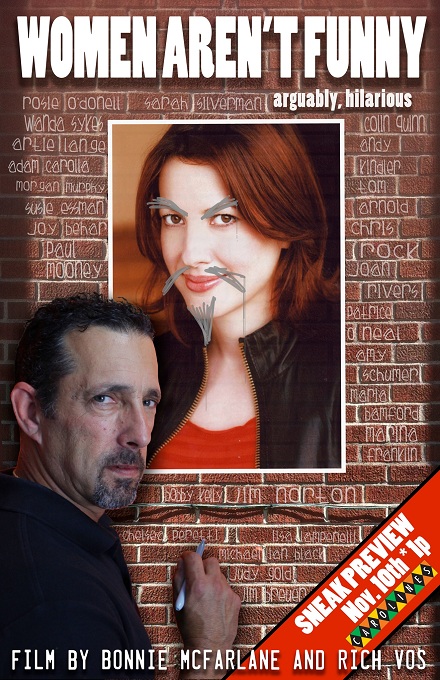
Speaking of Vos, the documentary directed by his wife Bonnie McFarlane (and produced by Vos) will be sneakily previewed at Caroline’s at 1 PM, Nov. 10, as part of the New York Comedy Festival. The movie will be followed by a panel discussion– the moviemaking couple will be joined by Susie Essman, Morgan Murphy and others.
The PCH to the VCF
The Male Half scheduled a spot at the Comedy & Magic Club in Hermosa Beach on Friday night. He also had to be in Ventura to do two “Headliner Showcase” spots as part of the Ventura Comedy Festival. We planned a quick, in-and-out trip to SoCal.
Just a couple days before we lit out across the desert, we found out that the folks in California who fix things were planning to shut down ten miles of the 405 Freeway in Los Angeles so they could demolish (and eventually fix) the Mulholland Drive Bridge. And, since the 405 is a main, main, main traffic artery in Los Angeles, the media and the politicians were convinced that everyone in Los Angeles was going to freak out. They called it “Carmageddon II!” (Carmageddon I was a year ago July.) They advised everyone to “stay local!”
Of course, none of the predicted chaos and mayhem occurred. We overnighted Friday at a motel near LAX, then headed up the legendary Pacific Coast Highway to check in to our Saturday night lodgings in Oxnard. (Oxnard! How utterly appropriate that we stay in Oxnard– familiar to many who watched Johnny Carson-hosted Tonight Shows, as Carson’s imaginary tailor was “Omar of Oxnard.” It never failed to get a laugh!)
We dined at Henri’s of Oxnard, but we didn’t find any Omar’s.
Safely 35 miles west of the traffic anxiety of the Los Angeles basin, in the heart of the strawberries and lima bean fields of Oxnard, we focused on Saturday evening’s festivities.
In addition to being a comedian Randy Lubas is also a partner in the Ventura Harbor Comedy Club (VHCC) and, for the past coupla years, he’s organized the Ventura Comedy Festival (“Laughter By The Sea”) which boasts more than 100 comics in six venues over 27 shows.
The harbor is a classic California crescent of shops, restaurants and free parking overlooking an eye-popping array of sailboats, peppered with pelicans and seagulls and happy tourists and locals. The VHCC– a high-ceilinged, second-floor rooom that holds 150 or so– has been a comedy venue off, and on, for at least 20 years. And for good reason– it’s got some sort of standup mojo and perfect dimensions that magnify the laughs and practically guarantee a great show. When we arrived, the TV Showcase was causing a stir. The Male Half poked his head in the room, just to get a handle on the space. Twenty minutes later, he realized that he had done a show there waaaay back in 1992 or so, when it was called Hornblowers… or was it The Golden Sail?
After an 8:00 show at the tiny, wine and tapas bar that served as one of the six Fest venues, we headed back up to the VHCC for the second of the evening’s Headliner Showcases.
Festivals, no mater how large or small, are tremendous opportunities to establish relationships and renew old connections. (Sounds cliched, but it’s damn true!) We were tickled to be able to meet/hang with/re-connect with folks like James P. Connolly, Grant Cotter, Warren Durso. Bill Kalmenson, Andrew Norelli, Erik Passoja. David Race, Aldo Juliano, Rondell Sheridan, John Mendoza, Sid Davis, Paul Steocklein, Lisa-Gay Tremblay and Johnny Walker. Interestingly, there were four people in the house– The Female Half, The Male Half, Aldo Juliano and David Race– who all had an intimate connection to the Philadelphia comedy market at one point or another over the past 20 years… but had never met! It is at such festivals as this that those dots are connected. Also in the house– XM/Sirius Radio. Also in the house, due to his connection to XM/Sirius– star of stage, screen, television and radio (terrrestrial and satellite), Jay Thomas!
Lately, we’ve been just dreadful at taking pictures. In the past, we would have been snapping away and we would have supplemented our words with images. We’re always forgetting to document our exploits visually! We think it’s because of the fact that we’re carrying around smart phones with cameras built into them. It’s a paradox. One would think that having a reasonably sophisticated camera in one’s pocket or pocketbook would mean that more photos are taken. Well, that may be so with other, normal people. It works quite the opposite with us. (We even went out of our way to purchase a kinda costly “bridge” camera about a year ago, in hopes of upping our photo output. It has resulted in FEWER PICTURES! We have to work on that.)
Comedy Bloghorn # 6
How about another quote?
Freedoms must not interfere with the freedoms of others. If someone insults, what would you do? Is insulting other people not a form of crime?
That’s from the UN speech by the freedom-loving Mahmoud Ahmadinejad.
Theft, magic, comedy, shame
Sounds like a Red Hot Chili Peppers album. But it’s just all the elements that ping pong around our heads when we read this article in Esquire, about Teller’s encounter with a magician who ripped off his signature bit, “Shadows.”
In the article, entitled “The Honor System,” Teller’s travails in dealing with the thief leads into a mini profile of magic trick inventor Jim Steinmeyer, who, tired of being ripped off, has pretty much ceased creating tricks and has taken to writing about magic instead.
Along the way, ideas like honor, patents, thievery and inspiration are explored. One of Steinmeyer’s “builders,” Bill Smith, says:
“Things are just out of control,” Smith says. “It’s the world, and it’s getting worse. There have always been thieves in magic, but thievery has never been so bad as it is now. The biggest shame is, guys like Jim– Jim is retreating. I’m sure he has tons of other good ideas, but he’s not making them, because it’s not worth it. He’s writing books instead.”
In one of those books, Steinmeyer writes that “the best tricks are a “collection of tiny lies, in words and deeds, that are stacked and arranged ingeniously.”
Tricks are compared to jokes.
Like jokes, tricks should have little plots with a twist at the end that’s both implausible and yet logical. You shouldn’t see the punchline coming, but when you do see it, it makes sense. The secret to a great trick isn’t really its method; the method behind most tricks is ugly and disappointing, something blunt and mechanical… What matters in magic is the idea– not just the idea, but the expression of the idea.
Steinmeyer expresses some exasperation at the theft.
“A great trick, like a great song, should be an inspiration,” Steinmeyer says. “It should lead you to other things that are also wonderful. That’s what happens in literature, and it happens in music, and it happens in art. But in magic, they don’t do that. They just take it. You would hope that what you do inspires, but instead it just inspires theft.”
We’re compelled to examine the difference between magic and standup. It seems that 50 years or so ago, when, according to our pet theory, comedians evolved into the “singer-songwriter” mode, comics (and maybe their agents and managers) got a little more stern about enforcing intellectual property claims. We theorize that television may have had something to do with it. We here at SHECKYmagazine were even quoted in an abstract by two fellows at the University of Virginia School of Law! (Read “Woe To Those Who Violate Our Norms-Based IP System!”)
Magicians, it seems, have never had a “norms-based system of IP enforcement.” Quite the contrary– young magicians start out with a “magic kit,” master certain “traditional” tricks, then shape and mold an act around those elements. All the while, their colleagues seem not to flinch at using tried-and-true tricks. Indeed, they seem to encourage the dissemination of such tricks throughout the community– to the point where, the article’s author points out, “many magicians have convinced themselves that every trick is fair game so long as they’re able to crack its code.”
Yet there are many magicians out there who have gone to great lengths to separate themselves from the pack, to be meta-magicians– much like Penn & Teller, who, the author says, have invented “a ridiculously poetic method” of exposing the trick. Or, in some cases, inventing a poetic (or comical) method of winking at the audience while doing technically spectacular illusions.
Read the whole article. It’s fascinating.
The crank speaks
Deadline Hollywood super crank, Nikki Finke, regarding the Emmy award for Julie Bowen, says some dumb stuff about comedy:
Listen-up, Hollywood: beautiful actresses are not funny. They don’t know how to do comedy. (As Bowen demonstrated with her acceptance speech that repeated the phrase ‘nipple covers’ 3 dozen times. To zero laughter.) Only women who grew up ugly and stayed ugly, or through plastic surgery became beautiful, can pull off sitcoms or standups. Bowen isn’t a comedienne. Because it’s all about pain and humiliation and rising above both by making people laugh with you instead of at you. So stop casting beautiful actresses when you should be giving ugly women a chance. This also applies to handsome men, by the way. Now argue amongst yourselves.
Of course, Finke is being deliberately provocative. It’s how she attracts the vast majority of her readers. Were she to merely write about Hollywood– sans the snark– her blog would be nothing more than a snooze-inducing electronic industry newsletter with gossip of interest only to the H-wood one-per centers.
World Series of Comedy 2012
It’s over! The winner of the 2012 World Series of Comedy is… Landry! The one-named, Atlanta-based comedian beat out Tyler Boeh and Alycia Cooper in the finals last night at the Tuscany Suites Hotel, bringing the six-day competition to a close. Did we get a picture of the winner? Er… Uh… no. We will run a pic from Tanyalee Davis‘ Facebook feed:

That’s Tanyalee on the left. Landry on the right. Tanyalee was passing through town on the way to the San Francisco International Comedy Competition. (That’s going on this week through October 6.)
By all accounts, the WSOC was a smashing success. Landry won the top spot among the comedians. And the Tuscany won high marks from all the attendees. (This year was the first year that the WSOC was held at the new venue. When WSOC Commissioner Joe Lowers moved his show from the Alexis Park to the Tuscany earlier this year, the World Series naturally came with him.)
That’s the Commish. Snapped just outside the T-Spot, the showroom where it “all went down.”
It’s been some time since the “Fryers Club” (sic) has been held in Vegas. That’s the informal gathering of comics that occurred weekly here in the desert over the past couple of years. All local comics– and any comics visiting town– were encouraged to attend. It’s been moribund for the past few months for a number of reasons, and has occurred only sporadically. This week, it happened over several nights, at the Tuscany, as several visiting comedians– Mike Saccone, Larry “Bubbles” Brown and Paul Ogata among them– joined some of the late-night, post-WSOC gatherings at the bars inside and outside the T-Spot. And Lowers created laminated passes for many of the local (or “resident”) Las Vegas comedians.
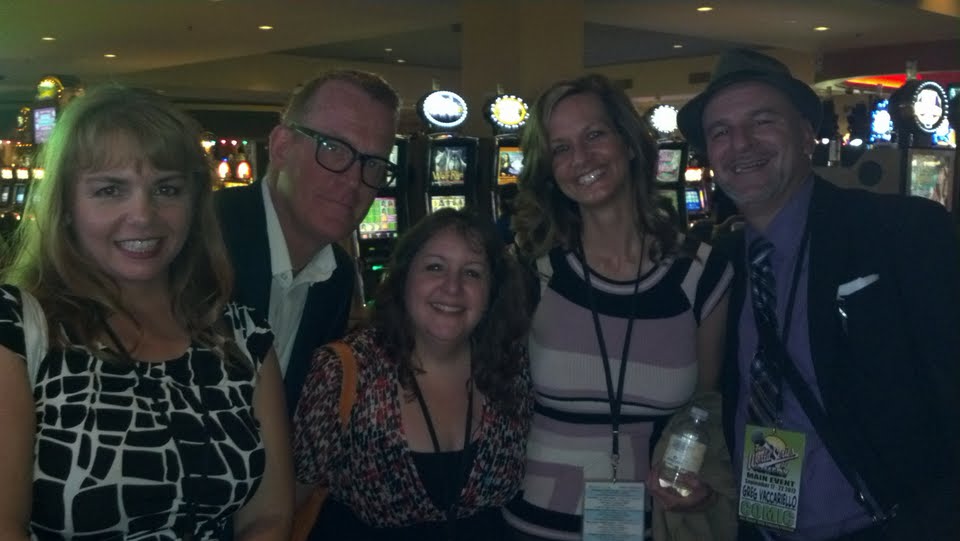
Left to right: Traci Skene, Brian Mckim, Amy Pittle (Big Al’s Comedy Club, Orleans), Mellisa Vacariello, Greg Vacariello
The Male Half participated (all-too-briefly, as he is a terrible poker player) in the WSOC Poker Tournament, held Friday afternoon at the Tuscany. But he had a splendid time working all week at the new Laugh Factory at the Tropicana alongside Judy Tenuta.
That’s a photograph of the DiamondVision marquee outside the Trop. That the Male Half’s name, in letter several feet high. (It’s running over a Judy Tenuta music video but the “shutter speed” of the Female Half’s Droid 3 makes it look like it’s been through a Cuisinart.)
We always marvel at the bonding that goes on at these affairs. When you consider that, out of about 150 comics that show up (of which 101 actually compete), only one “wins,” the real benefit of such gatherings is a crazy, alcohol-fueled stew of networking, bonding and debauchery that takes place, day and night, that starts on Monday afternoon and roars on for five more days. Many of those in attendance will forge enduring relationships over bowling, poker, steak and eggs, $1.50 Fosters and impromptu treks to any of a number of comedy venues throughout LV.
There’s “industry” in attendance– and that’s important… and a lot of business cards get swapped. (And it’s surprising that there isn’t more. Agents and managers are always bellyaching about seeing the same people over and over again at the major fests. And they’re always bellyaching about how all those same acts are already nailed down by this agent or that manager. But this is a “fest” (technically, a competition, not a fest) that is not yet “corrupted” by agents and managers– there’s a lot of talent that is hungry and unrepresented. You would think they’d flock here. Throw in the backdrop of Vegas and it’s a wonder the comics aren’t outnumbered by industry types!)
We’ll be there next year.
Check out our our 2010 WSOC coverage.
Comedy Bloghorn # 5
How about a quote from Voltaire:
“To learn who rules over you, simply find out who you are not allowed to criticize.”
One wedding and a funeral
There’s the happy couple– Kristeen von Hagen and Luciano Casimiri– minutes after they were joined in holy matrimony. They’re Friends of Shecky and they’re also comedy writers and performers from Canada. (And that’s the Female Half of the Staff in the lower left snapping virtually the same photo that she appears in. We’re too tired to frump up some sort of gratuitous Rashomon reference.) The couple currently reside in Toronto.
We attended the happy ceremony at the Flamingo just two days after attending a different kind of celebration. On Monday afternoon, we traveled to Big Al’s Comedy Club at the Orleans here in Las Vegas to attend a celebration of the life of comic Ron Shock, who passed away on May 17, after a shockingly short battle with cancer. The affair was alternately poignant and riotous, which, we are assured, is just the way Shock would have wanted it. (Neither of us had spoken to Shock more than a handful of times here and there over the past 20 years, but we are friends of many of his friends.)
Shock was eulogized by Chris Bliss and host Nancy Ryan brought up Shock’s son Hudson Shock, followed by Todd Paul, John Padon, Michael Paskevich, Steve Epstein, John Biddle and Winston O’Rourke, all of whom shared their personal memories of “The Storyteller.” The tribute was capped off with a lovely montage, created by John Bizarre.
It’s reassuring to see comics coming together– to memorialize a lost comrade or to celebrate the joining of two fellow comics. We often hear comedians characterized as isolated, cynical, uncaring, unfeeling. Of course, we often are all those things, but that’s not all we are and we can be counted on to support our comedy buddies when tragedy strikes. And when we’re invited to be part of a joyous occasion, we are thrilled and we respond with genuine gratitude and happiness.
The backdrop of Vegas gives both events a surreal quality. Vegas is a happy, raucous, chaotic place most of the time, so it’s ideal for a wedding! But it is an oddly appropriate place to grieve. Coincidentally, this is the second time that we’ve attended a wedding in Las Vegas shortly after a funeral– the first time being in 1997, when, shortly after the death of The Male Half of the Staff’s sister, we traveled to LVNV to attend the wedding of an old friend. Death, followed by a celebration of life. It’s classic.
The circle of life and all that.
How’s this for a harmonic convergence– Nancy Ryan, who hosted Monday afternoon’s memorial (and is the featured comedian at the Flamingo’s “X-Burlesque” show) tweeted the following on Wednesday night (the night of the wedding):
Pulled my Honda into Flamingo valet… right next to Russell Peters‘ Bentley.
Unbeknownst to Ryan, Peters was upstairs at the Flamingo, deejaying at the von Hagen-Casimir post-wedding reception/bash! (That’s right– Peters, in addition to being a superb comedian, is also a deejay… and quite a smashing one at that!)
To quote Steven Wright: “It’s a small world. But I wouldn’t want to have to paint it.”
Sometimes Ask A Man by Traci Skene
 The Female Half has penned a book, now available at Amazon.com!
It’s called “Sometimes Ask A Man” and it’s getting rave reviews!
We here at SHECKYmagazine.com have been fascinated by newfangled technology since waaay back in 1996, when we built and uploaded our first electronic press kit. Fast-forward 16 years and the idea of a Kindle Single– an electronic book that’s longer than a magazine article but shorter than a book– caught our attention.
The Female Half set to work cranking out a hilarious 23,201-word e-book that lightheartedly analyzes the ancient and mysterious relationship between men and women. Using the 1965 book “Always Ask A Man” as a jumping-off point, TFMHOTS touches on feminism, drinking, marriage and sex. What could possibly go wrong?
With stupendous cover art by Ambrose Quintanilla, it’s available via amazon.com for only $1.99! It’s readable on your Kindle (all versions!) and you can also read it on your laptop, desktop, netbook, iPad or other tablet computer– even on your smartphone! Just hop on over to Amazon.com, download the appropriate (FREE!) Kindle App onto your device, then download “Sometimes Ask A Man” and you’ll be laughing in no time!
“If you don’t give a man a chance to look after you, he’ll soon give up and let you look after yourself! Men have a natural protective attitude about women, so don’t keep trying to prove how self-sufficient you are.”
I think this chapter should have been called: The (Lost) Art Of Manipulation. It seems to be all about pretending. Don’t let him think you’re smart. Don’t let him think you’re funny. Don’t let him think you can balance a checkbook. Don’t let him think you think.
Couples need to look out for each other. Over time, we discover the strengths and weaknesses in our partners and adjust accordingly. At least, that’s what people in a healthy relationship do. My husband knows that there are times when he should be protective and times when he should just back the hell off. He likes to say, “She’s punched more people than me.” True. But that was in the 70’s and 80’s before litigation and assault charges became all the rage.
Comedians ignore Eastwood’s schtick
Clint Eastwood, the “surprise guest” at the Republican National Convention, delivered an 11-minute speech that was part serious but mostly comedy. Comedy? What evidence do we have that it was comedy? Well… Jokes.
We understand that not everyone might agree with the substance of Eastwood’s talk. We’re guessing, in the current climate here in America that about 48 per cent agreed with it, about 48 per cent disagreed with it and about 4 per cent were undecided. We don’t need George Gallup to tell us that.
But we would expect that professional comedians, upon observing the speech live or via Youtube, would be more interested in discussing the merits of the speech as a comedy routine or sketch. Or at the very least, they would acknowledge that it was mostly comedy. So few have done so.
Perhaps we expect too much.
The opinions that we’ve seen from our colleagues– in blogs, tweets and on Facebook– are pretty pathetic. Eastwood’s “insane,” he’s “senile,” he’s “an embarrassment.” But too many of the comedians we’ve seen holding forth on the performance aren’t inclined to use their experience as comics to lend some insight into the presentation. There’s precious little thoughtful analysis of what is, for the moment (and for a few news cycles at least), the most talked about comedic performance in the pop culture.
From the opening line– “Save a little for Mitt.”– to the recollection of the evening of Obama’s election (“Oprah was crying… I was crying.”) to the empty chair bit, it was a comedic monologue wrapped around a serious message at a gathering of delegates for one of the two major parties in America. Levity is so scarce at such events. Perhaps it shouldn’t be.
We’re puzzled as to why professional comedians would ignore the comedic element of Eastwood’s portion of the “show” and instead resort to base, contemptible, brutish character assassination.
To be sure, a handful of thoughtful comments can be seen here or there. It has been speculated that the empty chair device has been around since vaudeville, maybe even earlier. And some folks even drew a parallel between the empty chair conceit and Bob Newhart‘s or Shelley Berman‘s (or, we would add, in the interests of gender equality, Betty Walker’s) phone bits. Some even dared to defend the performance as pretty good for a non-comic and very good for an 82-year-old. But the defense has been meek in the face of such withering (and vicious) condemnation of Eastwood and anyone so gauche as to defend him.
We’re not interested in starting a debate on the quality of the performance, but we’re disappointed that so many comedians failed to put aside their opinion of the substance of Eastwood’s words (which, after all, were not all that controversial or mean-spirited) and offer some kind of thoughtful breakdown of the structure of the material, the reaction of the audience and any possible ramifications it might have for standup in general. Something fun, something light, something interesting to comedians and comedy fans. Instead, they’re rushing to put up links to articles that “fact-check” Eastwood’s speech or going on about the fact that Eastwood has seven children and how that might clash with the GOP’s ostensible stance on family values.
Is that what comedians have become?
How would comedians like it if the tables were turned? Suppose one of us mounted the stage and did a joke about a subject dear to the hearts of some audience members. And, the next day, our joke is ignored and we’re branded as batshit crazy, and our values, morals and dignity are questioned and we were condemned as a “worthless douchebag.” Oh… waitaminute… that’s already happening.
Wild Bill Bauer, comedian, 62
One of the “founding fathers of Minneapolis comedy,” Wild Bill Bauer passed away at his home in Inner Grove Heights, MN, according to the story in the St. Paul Pioneer Press.
The Female Half had the pleasure of working with Bauer in Mesquite, NV, back in 2005.
Idiocy on the high seas
We stumbled across this article on USAToday.com, which in turn led us to the original account (in the UK Guardian) of an Irish man who sued the P&O Cruises because the comedians on two cruises made Irish jokes.
Here’s the troubling part:
Wolfe brought a civil claim against Carnival Plc – the owners of P&O – under race relations legislation as well as the European Union’s race directive – a ruling which sets out the principle of equal treatment between persons irrespective of racial or ethnic origin.
Emphasis ours.
The European Union’s race directive? What the blazing hell is that?! And, if somebody who is “offended” by a joke can file a civil suit against the employer of a comedian (and win a five-figure settlement) because of it, what effect does it have on the artistic expression of comedians in Europe?
And in another incident— again involving a P&O cruise ship– an Australian woman is seeking $1 million.
Australia’s Sydney Morning Herald reports the 50-year-old woman, Kate Strahan, alleges a crew member serving as a judge during a singing competition on the ship told her he could see her underwear through her dress while she sang on stage, commented on her breasts and suggested she could “cougar” him any time. He also allegedly made inappropriate gestures toward an image of her projected on a screen.
The comments and gestures allegedly were made in front of an audience of about 1,200 fellow passengers, and Strahan’s husband has said the incident caused her so much stress she had to stop working, the Morning Herald says.
Of course, she might not get a penny. But it’s still troubling that she feels justified in bringing the suit in the first place.
Too many attorneys in this world? Too much political correctness? Too much greed? Are some folks just against fun? Or an out-and-out hostility toward fun?
Phyllis Diller, 95
Phyllis Diller passed away. We never got to meet her in person, nor see her perform, but we felt like we did after seeing this documentary on Netflix.
Back in 2006, we stumbled upon a series of interviews with comics. We excerpted the following from Diller’s interview:
It’s wonderful to be able to do something that not everyone can do. Not everyone can play the piano. I’ll tell you what: You know how dear old Rodney Dangerfield says “I don’t get no respect?”
When you play the piano, you get a lot of respect. Because here you are with an audience of 3,000, and maybe 15 people can play fair in that audience. Your art show. People are coming and looking at your art and going “ooh!” and “ahh!” and buying it. Not everyone can paint.Everyone can talk. Some of them can even sing. In fact they get in the shower and they think they’re pretty hot stuff. Now… This is why comics don’t get the respect they truly should: People think they even know how to tell a joke. Most of them don’t even if they have an audience. If they have an audience they will elongate. They’ll pad it. They think, “Oh my golly, they’re loving this!” They aren’t loving this. They already know the answer, maybe. They’re maybe being polite.
But you see, they look at you and if youre really good, they think your ad libbing they think you just walked out and talked. They don’t realize that 45 years went into getting the experience to looking that peaceful and looking like you know what you’re doing, and holding their attention and making them laugh. You are an impresario. You’re in charge. It’s power.
Just because you’re talking, they think they can do it. They think they can do it.
They know they can’t play the piano, they know they can’t paint. But they think they can do that. It looks possible.
Access all the interviews from the Archive of American Television here.
Don’t think it didn’t cross our minds…
…that this is where they put up the comics!
As you swing around the corner in the lobby of the Edgewater Hotel Casino (The Male Half was headlining at the comedy club there last night) in Laughlin, NV, you see this, just to the left of the registration desk:

(It’s part of the Edgewater’s program to promote newly upgraded rooms!)
Who is that advertising up there at the top of the column?
It’s TheStandupComedians.com. At least it is/was until the ad comes/came down. Anyway, it’s interesting…
Paul Breau explains:
The idea for the comedy site came after watching Louis CK’s Live at the Beacon Theatre stand-up show. His DIY-style digital download site was a game changer. Fans could buy his comedy for $5 and do whatever they wanted with it. He wasn’t the first to do it, but he was the first comedian. And the idea that artists, even comedians, could deal directly with fans was very cool. Once Louis CK did it, other big name comedians quickly followed: Aziz Ansari and Jim Gaffigan both came out with their own downloadable website specials shortly after. I wondered if the same model could work for lesser-known comics.
We wondered, too. And we figured there’s no better place to advertise than here… after all, we reach a bunch of comedians and comedy fans.
We’re pleased to be part of such an effort.
It’s grassroots-y and it’s plucky! (And if there’s one thing we admire around here, it’s grassrootsiness and pluckiness!) And we’ve been wondering (quietly, to ourselves) if this Louis CK hoo-ha would result in the industry being turned upside down… well, it hasn’t… at least not immediately. But that’s not how industries get turned upside down. They get tilted slightly… then they get turned on their sides… then they get upended. And, like a piñata, the rewards spill out and everyone gains! (Sorry for mixing metaphors. But if there’s anything we admire around here, it’s grassrootsiness, pluckiness and mixed metaphors!)
And the folks at TheStandupComedians.com are helping to tilt the industry just a few degrees. And they’re whacking at the industry pi˜ata with fury… and we hope the candy is spilling out! They are: Erica Sigurdson, Graham Clark, Patrick Maliha, Ivan Decker, Dylan Rhymer, Charlie Demers and Ben McGinnis.
Somali comedians who mocked Islamists is shot dead
From the UK Guardian:
One of Somalia’s most popular comedians, known for his parodies of Islamist militants, has been shot dead in the capital, Mogadishu.
Abdi Jeylani Marshale was reportedly killed shortly after leaving a local radio station where he worked as a drama producer and performer.
Witnesses told the BBC that Marshale was shot several times in the head and chest by two men armed with pistols. The gunmen have not been caught.
A coupla comics discussing humor
Two prominent comedians, talking on a syndicated radio show, wondered aloud why there seems to be a reluctance on the part of so many comedians to make jokes about the POTUS. It got embedded by a bunch of websites and linked to off of Drudgereport.com.
We’ve been wondering why more comics aren’t doing jokes about the most powerful man on the planet. We watched, fascinated, as one writer, one comic, one late-night talk show host after another contorted himself/herself into knots explaining why the then-candidate/president-elect/president was so hard to make fun of… or that he was rightfully “off-limits” as the target of barbs. Of course, none of it made any sense at all and we declared that comedians were abdicating one of their responsibilities– to mock the powerful. Or, at the very least, they were inexplicably ignoring a rich vein of comedy gold that was theirs to mine. Our words either went ignored or we were mocked.
Seems like nothing much has changed. Our two prominent comedians sense that the current atmosphere is not good for comedy and not good for the nation. It’s a legitimate topic, worthy of further discussion and analysis. But don’t tell the commenters at HuffingtonPost.com. Predictably, the personal attacks arrive early and stay late. (“…he is a “B” lister at best,” or “…a couple of fading stars that on one even cares about anymore,” and “he took time off counting his 30 pieces of silver.”) We will grant that the commenters are, by and large, fans of HuffingtonPost.com, but we’re a bit taken aback by their lack of self-awareness when they say things like, “But the thing with Obama is that no matter what side of the political spectrum you’re on, you have to take him dead serious.” They apparently have no idea that they’re prime examples of people talked about in the clip and that it is precisely this kind of attitude that is worrisome.
It’s more of the same. Rape jokes are never funny. Joking about tragedy is not funny. Obama jokes are definitely not funny. (And, incidentally, anyone who indulges in same is fair game for the rankest personal attacks.) Are you seeing the pattern?
Showtime at the Apology
The title of this post comes from the Male Half’s tweet from July 27:

Cook created this week’s “Comic Under Fire for a Video/Audio Recording Taken Out of Context and Splashed Across the Social Mediasphere” controversy when he did a joke– onstage at the Laugh Factory in Hollywood, naturally– about the Aurora shooting.
So I heard that the guy came into the theater about 25 minutes into the movie. And I don’t know if you’ve seen the movie, but the movie is pretty much a piece of crap — yeah, spoiler alert. I know that if none of that would have happened, pretty sure that somebody in that theater, about 25 minutes in, realizing it was a piece of crap, was probably like “Ugh! f*cking shoot me.”
We briefly considered writing another opus defending Cook and taking some of our sistren and brethren to task for being such turncoats, pussies, scolds and weasels, but we decided instead to run the video below. It’s from August of 2009, taped shortly after the death of Michael Jackson. It’s Episode 1 of our video series, “Lying About: Standup” entitled “Is It Too Soon?” In the video, we bemoan the ridiculous comedians who, in the hours and days after the death of the King of Pop, took to Facebook and Twitter and told their colleagues that it was “too soon” to make jokes about Jackson.
The points we made three years ago are startlingly similar to the ones we make in 2012. It’s getting a little tiresome, defending our colleagues (against scurrilous comments often made by our colleagues!), but we can’t just let it slide. But it’s also getting tiresome watching our colleagues apologize.
I am devastated by the recent tragedy in Colorado and did not mean to make light of what happened. I made a bad judgment call with my material last night and regret making a joke at such a sensitive time. My heart goes out to all of the families and friends of the victims.
Particularly nauseating are the comments on the websites– sites that cater to both the left and the right– which trash Cook, trash comedians in general, and fail miserably to understand that one of the functions of a comedian in our society is to say the unsayable, to give voice to our darkest or most uncharitable thoughts in the service of evoking laughter. We often fail in doing so, but we should be given wide latitude. Cook, by the way, did not fail in this case– the reaction to the joke was described thusly: “His comments regarding the shooting were met with groans that morphed into loud laughter and cheers.” (Daily Caller) Which is as it should be. Does anyone, for one nanosecond, think that the assembled comedy fans who laughed and cheered that night were doing so out of some sort of vulgar or wretched disrespect for the victims or survivors of the Aurora shooting? Can we explain their reaction in a way that allows for some coarseness but also recognizes a healthy catharsis? Are we not told that one way we deal with our darkest fears is by laughing at them? Is this not a case of dealing with fears by laughing? Is it too soon? Apparently, not. Not for the people who showed up at the Laugh Factory a week after the shooting. They were probably keenly aware of the misery and death in Aurora. And they might have been at a comedy club to blunt their fear or their pain. And, who knows– maybe they were subconsciously skittish about being packed into a theater one week after the worst mass shooting in American history. Their reaction might have been borne of that collective consciousness. It may have been that Cook addressed their long-term as well as their vague, immediate fears. We’re speculating, of course. But have you seen some of the speculation as to Cook’s motivation? Have you seen the comments that call him everything from an insensitive douchebag to a has-been to a homosexual? (Yes… that’s right– the comments from left, right and center employ the the “triumvirate of ultimate put-downs.” So far, no one has figured out how his comments were “racist.” Give them time.)
And we just noticed that, in our last few posts, we’ve spent a lot of time defending the people who laughed. That’s kind of important, as the people who laugh are the people who buy our product– live, recorded, televised, etc. It would be deadly if the folks who laugh are made to feel– through repeated tongue-lashings from perpetually offended busybodies– that their laughter is almost as egregious an offense as the “reprehensible” jokes being told by the “potty-mouth” comedians. We stand by them, just as we stand by the comedians who’ve come under fire. Who would you rather have in the audience? The folks who laugh at “inappropriate remarks” or the people who videotape them and seek to squeeze apologies out of the most successful comedians on the planet?
Both Halves of the Staff on CooperTalk
Comedian Steve Cooper hosts CooperTalk, a radio show, taped in Burbank. “He hosts Comedians and Comedy Writers and spends an hour with them for some organic chat about the funny biz!”
We recently crossed the desert for a brief stay in SoCal– The Male Half did four nights at the Comedy & Magic Club in Hermosa Beach– and while we were there, we were invited by Cooper to be guests on his show. (We taped two weeks ago today and the link is here)
Cooper started out his comedy odyssey in Philly. He took a Learning Annex course on standup and the teacher was none other than The Female Half (with the Male Half “guest lecturing!”)… so the credit (or the blame!) for Cooper being in Burbank, on a Thurday afternoon in 2012, taping a radio show/podcast, rests squarely on the Female Half’s shoulders!
Tosh.Opus
We spent the better part of the last four days in Los Angeles, wallowing in standup comedy, performing standup comedy, talking to standup comics and those who respect them.
Naturally, the conversation drifted… or swerved… or careened directly and purposefully into the topic of The Great Daniel Tosh Rape Joke Controversy.
Is it over? Has the apology been issued and the wounds healed? Is the grievance industry on to the next affront? Are we wasting time fighting a five-day-old battle that is better left alone?
Ha!
Those intent on making some sort of ideological hay out of this whole mess are not letting up.
Judging from what we witnessed on two segments of an MSNBC.com show, Jamie Kilstein is the slimiest weasel in this business currently and Lizz Winstead is a close second. Winstead says that the defense of freedom of expression by her fellow comics is “hilarious” because it’s indicative of “narcissism.” Kilstein referred to Tosh as “the rich dude on stage with a microphone.” (Rich? Do you think that anyone in the audience cares if Tosh is rich? If any of their comedy idols are rich? We suspect the only person who cares about Tosh’s tax return is Kilstein.) And he characterizes Tosh’s remarks as “violently threatening her.”
“I say stuff, but I also don’t want to be a douche,” Kilstein says. Congratulations! You may not want to be a douche, but you seem to be! Apparently, it’s effortless!
Kilstein trots out the old trope that all comics are victims who have been bullied and that’s why we’re doing standup. Total bullshit, of course, but he uses the tired cliche to glorify himself and others– who are “punching up”– and characterizes Tosh and others as tyrants or bully comics who are now punching down.
Winstead speaks a bunch, but, curiously, says little. And what little she says is ambiguous. What matters most, we suspect, is that she has attached herself to a national/international controversy, she has made it onto another television show. Of course, they all seek to distance themselves from Tosh.
Elon James White talks mostly about himself, but sheds little light on the subject.
What is particularly galling about this circle jerk is that none of the participants seem to be sticking to the script we were handed. When SHECKYmagazine.com commented on this incident, we went by the account that appeared on the original tumblr.com blog called Cookies For Breakfast. Based on that, we determined that Tosh was responding to a heckler and he said an outrageous, exaggerated and ironic thing– that couldn’t be taken serious and that could in no way be interpreted to be a call for gangrape. We advised all to calm down and we also counseled that this was yet another in a series of incidents in which the perpetually offended sought, by intimidation and by the rousing of the mainstream media, to hem us in as artists and performers by telling us exactly what we can and cannot comment on when we do standup comedy. And we excerpted or linked to some of the over-the-top (and, in some cases, hate-filled) commentary on Tosh that followed on social media.
What is truly astonishing is to hear comics misquote or mischaracterize that which appeared in the original posting on Cookies For Breakfast. They are saying that Tosh “told everybody in the audience to rape her,” in so many words. Of course, this isn’t so. It makes for a great story if he did. But we’re going by her account. And, if we are to be scrupulously honest, he said no such thing. He said (again, according to the victim), “Wouldn’t it be funny if that girl got raped by like, 5 guys right now? Like right now? What if a bunch of guys just raped her?” Words mean things. That statement can, in no way, be interpreted as encouraging the audience to gangrape someone. Anyone who contends so is being dishonest. While we’re not unequivocally sure if they were his words, they’re the quotes from her account which she has yet to refute. They’re most certainlye not a call to rape. They are, as we apparently must repeat ad infinitum, an exaggerated, ridiculous rhetorical question which no decent person could interpret as a call to action.
What we personally learned in the past 72 hours or so paints a vastly different picture of what happened at the Laugh Factory last weekend. Of course, MSNBC could have perhaps tried to find someone who was present, but that would have entailed some real reporting… like a phone call or two, or maybe some emails or something.
Of course, we realize that MSNBC, a division of General Electric, doesn’t have the gargantuan budget and resources that we do.
But they can, it seems, place a few phone calls in order to summon three obviously biased comedians to the studio to reinforce their contention that Daniel Tosh is evil personified.
Take a look at the picture they used, 1.5 seconds after using the word “rape” for the first time in the report:
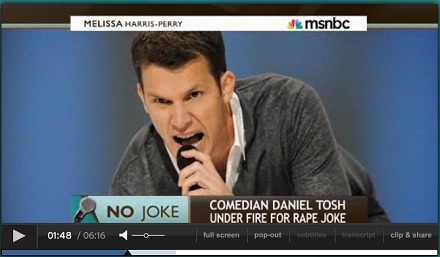
It’s a travesty. MSNBC should be ashamed of themselves. Apparently, they’re shameless. “MSNBC… Slump Forward.” They’re dead. Slumped over the steering wheel of television journalism.
We have been able to determine, through our casual conversation– and not through any tireless sleuthing or expensive “crack reporting”– a few facts that cast the interaction between Tosh and the Laugh Factory patron in a vastly different light.
Apparently, Tosh does a bit about… semantics, perhaps? From what we can tell, he delves into the subject of what comics can– and cannot– say. It’s a bit that he’s been doing for some time apparently. The premise of which is that he takes issue with the contention that certain topics are NEVER to be the subject of a comedy routine. Among them, he lists “rape.” (It is perhaps wise to discount Factory owner Jamie Masada’s account of the incident– he says that Tosh opened the discussion up to the audience and asked them what they might want to talk about!)
So, far from being a reactionary bully who was impulsively “hurling violent words about sexual violence” at a hapless, helpless victim. Tosh was doing a bit that sought, essentially, to stake out the boundaries of standup! It is the height of irony that, in all this discussion, Tosh is seen as a troglodyte. And those defending him are portrayed as knuckle-dragging cretins who enjoy non-consensual group sex whenever they can get it.
And, of course, let’s not even attempt to defend the audience. No! Tosh “incited a roomful of drunk people into guffaws about how hilarious it would be if a woman in the crowd was beaten into submission and gangraped.” (Actual quote from a Facebook comment!) Why have the batteries in everyone’s Civility And Over-The-Top Rhetoric Detectors suddenly gone dead? What the fucking fuck? How can any sane person (who wasn’t there) make such gross generalizations about a group of people assembled at a comedy club on a Friday night on Sunset Blvd. in Los Angeles, California, in 2012?
And how, we ask forcefully, can a standup comic with any sort of experience or any sense of honesty or decency make those same generalizations? How can our fellow comics assail Tosh– arguably one of our most successful and high-profile colleagues– based on such little evidence? Should not the default be to– at the very least– defend him until more evidence comes in, lest we err on the side of those who seek to limit our freedom of expression? Or is the career going so poorly that we automatically take the invite from the third-tier cable outlet– and sing the appropriate song– in the hopes that it will lead to some sort of gig that will enable us to pay for our 475 sq. ft. studio in Manhattan without having to sully ourselves by going over the bridge into Jersey and entertaining those gangrape fans at a one-nighter in Ft. Lee?
We’re appalled to witness this “ideological gangrape.” (Ours. Credit us.)
Also appalling is the gutless gang of comics who make a weak show of “defending” Tosh while simultaneously conceding that just maybe, when it comes to certain subjects, our speech should be limited. They cloak this nonsense jabbering about “responsiblity” or they say that “it’s okay if it’s funny,” or it can’t be offensive if “the joke is intelligent.”
It doesn’t matter. Whenever a comic encounters someone who says, “(Fill in the blank) is NEVER funny,” (and the key word is “never”) the conversation should end right there. It matters not if the statement is uttered by a drunk patron, a sober patron, a college professor, a newspaper columnist, your grandmother, the guy who picks up your dry cleaning, a fellow comic. There is no discussion. These folks “have a right to their opinion,” but their opinion is wrong. Utterly, totally, undeniably wrong.
It is wrong. Nothing should be off-limits– be it offensive or outrageous or ill-thought-out. This essential freedom is an integral part of our creative process. Every comedian should have said, “That woman is wrong. There are a lot of funny rape jokes out there.” And any discussion of “responsibility” or “apologies” or “taking flak” or “hurtful speech” is secondary to the larger issue of freedom of expression. Especially if we’re going on less than complete information.
A comic we spoke to– who witnessed the entire exchange– said that the comedy club patron spoke up, Tosh responded as was reported, got a huge laugh, and immediately went back to his act. Our witness also said that the complaining patron didn’t immediately leave and that, when she did exit, few, if any, noticed.
It is odd that no one in the mainstream media bothered to find out– beyond talking to the proprietor of the club– what happened that night. We’re frequently told that the world we’re entering– where Americans no longer get their news from TV or newspapers or magazines but from blog posts and tweets and Instagram photos– is a bleak, lawless and ultimately dishonest one where no one knows the truth and where facts are hard to come by and people are left to cobble together rickety opinions from disparate and untrustworthy sources. What we witnessed, however, was a mob who sought to ignore the few facts they were given while assembling– not a story– but a case. A case against a comedian. And they did it with the weak and biased assistance of such outlets as Mediaite.com and a lonely, anonymous blogger who was quoting an angry, anonymous (and humorless) woman. And they had help from supposedly “legitimate” legacy media outlets like MSNBC.
Even the vaunted Huffingtonpost.com, Yahoo.com and TheNation.com assembled shoddy, prejudicial collections of tweets and various other dubious bits of ephemera– from a host of questionable, possibly biased sources– to smear an artist in the name of some sort of rarified ideal that no one should ever make light of a subject that has been deemed “off limits.”
It is shameful.
On a lighter note: As The Male Half of the Staff was relaxing after a set at the Comedy & Magic Club this past Wednesday evening, a club staffer poked his head in the green room and took the time to tell TMHOTS just how much he enjoyed SHECKYmagazine.com’s most recent posting– about the Tosh controversy. He stated that it was apparently a particularly pertinent posting in light of the fact that TMHOTS does a “rape joke.” TMHOTS paused for a second, puzzled… before realizing that, yes, indeed, he DOES do a rape joke! Any idea that we here at SHECKYmagazine.com crusade wholly (or even in part) for purely selfish reasons are just a nasty rumor, as evidenced by the total obliviousness of TMHOTS to his own creative output. Of course, the more cynical among our readership may view that as TMHOTS’s total obliviousness to the sensitivities of those who have been, are currently or will soon be victims of rape. And further evidence of his total lack of awareness of his status as White Male Oppressor. To that, The Female Half of the Staff would respond: “Go fuck yourself!”
On a technical note: The Male Half tried doing this joke while substituting “attempted rape” with “attempted murder,” but it doesn’t get that big of a laugh. It may have something to do with the fact that rape (or attempted rape… or copping to attempted rape) is viewed as more horrific than murder (or attempted murder… or copping to attempted murder) and thus the joke is more “shocking.” And probably because “murder” has two syllables, whereas “rape” has one. Plus “rape” has that hard, punchy “P-sound” at the end. To the radical feminists in the audience, we would say that, sometimes it has nothing to do with rape and everything to do with mechanics… and the expectations, taboos and sensibilities of the audience.
On an even lighter note: The Male Half got into a Facebook skirmish with a fellow comedian (who he’s known for 14 years) over The Tosh Incident. This particular comedian savaged Tosh, saying there was “no joke” and that Tosh “just wanted her raped.” TMHOTS responded by making a few of the points we’ve been making here at SHECKYmagazine.com only to be called a “complete asshole!” That was followed by:
Your self righteous diatribe is ridiculous and makes YOU look like a bully. How about this Brian…I hope you get ass raped over you trying to insult me in a public forum. How’s that for ironic douche bag?!!! OH, NOW I’M FUNNY!!!!! NOW I GET IT!!!! By the way, your act will never get you in trouble because it doesn’t make any “real” controversial statements, so feel free to weigh in on shit you know nothing about. Rent a car jokes are safe. Stop trying to be so relevant when you’re not. Now follow the pack and continue to feel important with your blog that nobody reads.
It is puzzling. Comics do this all the time. Having lost an argument (or, worse yet, thinking they have won an argument!), they resort to the “You aren’t funny/ you are a hack/ I never thought you weren’t funny” mode of attack. It’s laughably juvenile.
His postings smack of nothing more than an attempt to draw a line between himself and Daniel Tosh, whom he views as an inferior, outmoded reactionary. We’ve seen it in other postings this past week. Weasely comics seeking to elevate themselves while simultaneously seeking to denigrate Tosh.
Beyond that, The Male Half is confused. If his act is so banal, why then do he and The Female Half so vigorously defend the freedom of expression of those who are far more controversial? And, furthermore, if The Angry Facebooker is so cutting edge and avant garde, why then is he so willing to throw Tosh and others of his ilk under the bus?
It is a staggering myopia. They can’t see how this might one day come back to bite them in the ass.
“Oh… it’ll blow over.” That’s what some of our colleagues have said. We understand how some folks would say that. It’s what we like to call “wish-y thinking.” It’s what you wish to happen. But it ignores the possible consequences.
Like?
Well… yesterday, at Comic-Con (the annual gathering of geeks and comic freaks in San Diego), Comedy Central, at what was no doubt a meticulously planned and calculated event, revealed the pilot for Tosh’s new animated series, Brickleberry. CNN reports:
The animated show about forest rangers focuses on adult characters. Rumors swirled (but even RumorFix commenters were pointing out inaccuracies) in the run up to the panel that the cartoon was frantically getting scrubbed of any rape jokes before its Comic-Con debut.
Yay, free expresssion! Wahoo! Daniel Tosh can create a twisted, animated series for Comedy Central… so long as it doesn’t have any jokes about rape, all right? Okay! Sounds good! Seth MacFarlane is probably bursting with pride.
Further on in the article, there is an account of a comedy team, Paul & Storm, who did a show nearby the Comic-Con:
The night before the “Brickleberry” panel, nerdy musical comedy act Paul & Storm presented a skit at w00tstock that analyzed levels of inappropriateness and their relative possible humor.
…The comedic duo proceeded to plot examples of inappropriate topics on an X/Y axis, defining which topics were safe or not so safe for a comedian to tackle.
Rape was not plotted on their skit’s graph.
“Apparently in (Tosh’s) act, he was trying to make that point that anything can be funny,” said Paul Sabourin of Paul & Storm, “but from what I can tell he was doing it in a pretty unartful way.”
Later on, Storm makes a point about how a comedy club is a place “where things were expected to get uncomfortable,” but, “Now, of course, anything that’s said anywhere can potentially be said everywhere.”
“Exactly,” Sabourin said, “just ask Michael Richards.”
Does anyone feel a chill?
Essentially what he is saying is that, in the wonderful new rape-joke-free world, comedy clubs will be stripped of their context.
Does anyone need further evidence of the effects of these blog-, tweet- and activist-driven jihads, fueled by such hacks as those at TMZ.com, Mediaite.com and MSNBC? In countless interviews, blogposts, tweets and Facebook status updates, Tosh was (unfairly) linked to Michael Richards. Now, the meme has taken hold. Tosh was, near as we can tell, doing a bit about the boundaries of standup comedy when he was interrupted by a self-centered, self-important, humorless boob. 72 hours later, he’s assailed by thousands on various social media.
One week later, in a report on Comic-Con on CNN.com, it’s implied that his pilot has been scrubbed of certain references. And performers at that conference say that “a simple apology, and one that’s unequivocal, is usually a good thing.”
Mission accomplished.
Check out the total horseshit in Slate.com! Slate says that any topic can be joked about “when done correctly.” Uh huh. They leave it unsaid as to whom exactly shall determine when a joke is “done correctly.” It is this ambiguity that is extremely dangerous. And it is this ambiguity that they count on to purge standup of any topics they deem unacceptable.
But, just to be helpful, the author (who is some asshat who worked as “a sports editor at Yahoo! U.K. in London and as a contributor for the Riviera Times in Nice, France.”) is now a fucking expert on standup comedy and offers these helpful tips:
A joke that ridicules the victims or potential victims of rape is just as terrible as one that mocks victims of lynching. If you’re going to make a joke about rape—- or lynching, or the Holocaust—- you should, as Lindy West pointed out in her excellent response to the incident on Jezebel, make damn sure that you are not ridiculing victims. And you should try to make damn sure that your joke has a larger point—- that the joke, in other words, is worth it.
Perfect! Slate has figured it all out. Now, jokes have to be “worth it.”
Sadly, some of our fellow comics would read the above and say, with a straight face, “Well, my jokes are worth it.” And they would be oblivious to the horrifying re-arrangement of the dynamic that they previously worked in. Now, they had better beware of the “P.C. Police.” There are other people participating in the creative process. And they don’t have our best interests in mind. Creating our standup no longer seems to be a matter that is between us and the audience. People who aren’t even present when you perform will be able to make judgments, without all the facts, with incomplete information.
And, finally, this past weekend, in two separate incidents, two comics– Tammy Pescatelli and Eddie Griffin— had drinks thrown at them by audience members who were offended by what they said onstage. Coincidence? Perhaps. Perhaps not.
First they came for the rape jokes, and I didn’t speak out because, after all, my rape jokes are insightful and done correctly. Keep dreaming.
Of course, the P.C. Police don’t have any power to arrest anyone. They are merely “deputies” who have been invested with the power of those who seek to shape, carve and mold the way we (comics, performers in general, anyone) talk about things.
Are you going to force us to dredge up the experiences of Lenny Bruce? Remember what happened when it was discovered that he was using the word “cocksuckers” onstage. From an account in Salon.com, back in 2003:
Bruce brought the house down. But among the guffawing hipsters, goateed existentialists and black-bedecked jazz fans (tenor great Ben Webster was also on the bill) was a man who was not laughing. He was a San Francisco policeman named James Ryan, who had been sent to the club by his sergeant, James Solden, with instructions to see if anything of a “lewd nature” was going on.
…After a brief conference, Ryan and Solden decided they had heard enough to arrest Bruce. As the crowd from the 10 p.m. show left, Ryan and Solden informed Bruce and the club owner they were arresting the performer for obscenity and escorted Bruce to the police call box in front of Enrico Banducci’s Hungry i.
Hey! Guess what? The bit Bruce was doing was “worth it.” And it made a point. And it was done correctly. All that didn’t matter to the officers. He was arrested anyway.
Do you trust ANYBODY else to make the call that your shit is “worth it?” That it’s “done correctly?” That it makes a point?
These folks seek to herd artists into doing their art “for the good of society.” And, conversely, they seek to ruin those who don’t feel inclined to do their art for the good of society. Pardon us if that doesn’t give us the fascist willies.
God help us, we agree with The View
Sarah Devlin, writing for Mediaite, reports that the three comedians who make up the bulk of the panel on ABC’s The View defended Daniel Tosh’s rape joke.
Joy Behar, Sherri Shepherd and Whoopi Goldberg, however, took the position that if the joke is funny and works, just about anything is fair game. As an example, Behar read a joke of Sarah Silverman’s aloud: “I was raped by a doctor, which is so bittersweet for a Jewish girl” to a big laugh from the audience. It was an interesting position in that it managed to be critical of Tosh’s joke (which they all agreed was unfunny and inappropriate) while also affirming the right of comics to try out new, outrageous material– provided they can take responsibility for it if it bombs.
It’s a heavily qualified defense. (But we can understand why– they’re on a daytime television show that has perhaps a 95 per cent viewership.)
But it’s heartening that Behar actually quoted Sarah Silverman‘s joke. The joke pretty much destroys the number one contention by those who condemned Tosh most harshly– that is that rape jokes are never funny. And after that collapses, there remains only one other criticism of Tosh– that his particular joke (which was really a response to a heckler) wasn’t funny. Of course, this is not much of a criticism as 1) none of us were there and we have only the account of the complainant to rely on and 2) comedy is subjective, so, while many of the complainant’s supporters may think the response was ugly, vicious, cruel, violent (take your pick), we thought it was a fine example of a response that used absurdity, exaggeration and irony. And that only a moron would believe that he was honestly trying to incite a rape or that anyone present would be so moved. So… it’s a wash.
Death is never funny
Child molestation is never funny.
No one should ever joke about domestic violence.
A comic should never joke about the holocaust.
If you make a joke about the loss of a child, it says a lot about you.
Drunk driving is not a subject that anyone should take lightly. Any joke about drunk driving just promotes the practice.
Doing material about abortion is never, ever funny.
Jokes about president Obama should be off-limits.
Jesus should never be the topic of a comedian’s presentation.
Gay jokes are not funny. Period.
Who could possibly make jokes about AIDS?
Do you really think that joking about stalking is appropriate?
Racist jokes are not funny. And if you don’t know which jokes are racist, then you are plainly racist.
Jokes that hurt someone’s feelings are not funny at all.
Jokes containing the word (fill in the blank) are never funny.
“Family Guy is not humorous and I’m sick and tired of ‘it’s just a joke’ type responses to people who are seriously harmed by society’s approval of jokes that target an oppressed minority.”
Humor that “punches down” is not funny. You’re just a bully, not a comic.
It isn’t humor if it hurts. That’s just insults.
Jokes about Muhammed are not funny.
Rape jokes are NEVER funny.
We live in a “rape culture,” dontcha know
On the one side of this world, we have comedians and the people who “get it,” people with a sense of humor. Comedians say outrageous things, they say goofy things, they say profound things and, it is hoped, all these things they say are funny. And the people with a sense of humor understand the deal.
On the other side of this world (not literally, but figuratively), we have people utterly lacking in a sense of humor. They quite often profess to be intelligent, caring, empathetic, etc.
And recently, a person in the second group (for reasons that are unknown, and, we suspect, unknowable) wandered into the Laugh Factory and watched a performance by Daniel Tosh.
And this person went home and told her friend about her experience and her friend then blogged about it.
And now we have another huge blowup where a comedian is being branded as “mysogynist.” And worse.
It all starts with a blog posting with a secondhand recounting of how some idiot girl/woman goes to the Laugh Factory…
So Tosh then starts making some very generalizing, declarative statements about rape jokes always being funny, how can a rape joke not be funny, rape is hilarious, etc. I don’t know why he was so repetitive about it but I felt provoked because I, for one, DON’T find them funny and never have. So I didnt appreciate Daniel Tosh (or anyone!) telling me I should find them funny. So I yelled out, “Actually, rape jokes are never funny!”
(The whole posting is hysterical, actually. Go read the whole thing if you haven’t already. It’s absurd. And Tosh comes off sounding pretty humorous.)
At this point, though, it gets really funny!
After I called out to him, Tosh paused for a moment. Then, he says, “Wouldn’t it be funny if that girl got raped by like, 5 guys right now? Like right now? What if a bunch of guys just raped her…”
We can see Tosh delivering this with that grin. And we understand, 110 per cent, why he said it. And we think it’s rather humorous. It falls under the category of exaggeration. With a touch of outrageous.
Of course, idiot girl doesn’t quite understand. She’s “stunned!” She finds it “hard to process!” She knows she needs to “get out of there!”
The horror! Quick! Hurry before you get gang-raped!!! IN A COMEDY CLUB! Yes!! It happens all the time! The horror! And, just like the higher incidence of domestic violence on Super Bowl Sunday, we suppose that there are thousands of women raped at about 1 AM every Friday and Saturday night throughout America, because of all those rape jokes told in comedy clubs throughout Standup America!!
Holy mother of God, this woman is stupid.
She leaves. She complains.
Now in the lobby, I spoke with the girl at the will-call desk, and demanded to see the manager. The manager on duty quickly came out to speak with me, and she was profusely apologetic, and seemed genuinely sorry about what had happened, but of course we received no refund for our tickets, but instead a comped pair of tickets, although she admitted she understood if we never wanted to come back. I can imagine the Laugh Factory doesn’t really have a policy in place for what happens when a woman has to leave in a hurry because the person onstage is hurling violent words about sexual violence at her. Although maybe I’m not the first girl to have that happen to her.
No… we imagine they don’t have such a policy. Mainly because… IT’S A FUCKING COMEDY CLUB! And only people utterly lacking in a sense of humor would interpret Tosh’s comments as “hurling violent words about sexual violence.”
Anyway, like we said, the account gets blogged about, with the preface, “This is something that happened to a friend of mine in her own words.”
And it gets reposted again. And again. And again.
And the subsequent reposts are prefaced with statements like…
Sexual assault is a violent and demoralizing crime that happens to far too many people on a daily basis. The struggle to reclaim one’s life after such an attack is nothing short of Herculean.
Sexual assault is not something that one ‘gets over’ or ‘gets past,’ but is simply always there. More often than not, it is incorporated into the fabric of one’s being, which is forever altered. Reading the story below, outlining two women’s experiences at the Laugh Factory, made me sick to my stomach with outrage, fearful for the women involved, and disgusted that no decisive action was taken against Daniel Tosh.
Sexual assault is never a joke. It is serious crime that still rages through society worldwide. Unless we continue to raise our voices, change cannot happen. Today, I chose to raise my voice.
And then tweets go out that say things like…
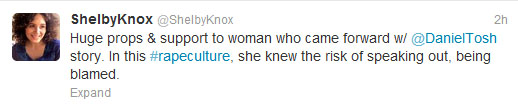
And, sadly, Tosh is eventually forced to apologize.
We’re disturbed by the whole incident, but not surprised. (Among the many disturbing elements of the story is that the Factory offered comps for a future show! For God’s sake, DO NOT let this moron back into your comedy club again! This is exactly the kind of person that is BAD FOR BUSINESS! An utterly humorous cretin who yells out in the middle of a set!)
We’ve been warning our readers about political correctness for 13 years or so. It seems that few grasp the seriousness of the situation. We see incident after incident where “concerned” and “enlightened” and “empathetic” people mount rather impressive campaigns to squeeze an apology out of a comic. And we’re appalled at the damage that is done to artistic freedom. And equally appalled at those who don’t see that damage. Or if they do, they almost immediately forget about the incident and carry on as if nothing happened. (We realize that Tosh’s apology was probably forced by Comedy Central. But the public spectacle of a comic apologizing– again!– is not a good one. It’s disheartening.)
We’re reminded of something we wrote back in April of 2008 when Tracy Morgan ruffled the feathers of some very concerned students during a performance at Cornell. According to the account in the student paper, “Morgan kept repeating that the audience was just not feeling him enough and that they were judging him joke for joke,” then shouted to the students, “I know you’re all intellectuals, but I don’t give a fuck!”
To which we added:
Comics should be aware that the bulk of the pressure on us (and on comedy audiences) to constantly “give a fuck” comes not from those groups which are traditionally seen as buzzkills (the Right, Conservatives, Christians, school marms, think the adults in “Footloose”), but from those groups traditionally seen as upholding the finest principals and practices of “progressivism” (the Left, Liberals, free spirits, think the kids in “Footloose”). We caution all comics to look both ways before crossing the line. Just so when you get smacked on the back of the head, you won’t be surprised which direction it came from.
Of course, we’ll be back on Facebook in three or four days and comics will be bitching and moaning about just how oppressive the right is and how bleak, brutal and depressing this country will be when the Christians take over (and how heavy-handed and dictatorial they are currently!). All this moaning misses the fact that the more tyrannical and troublesome rhetoric and action is coming not from the churches or pulpits throughout the land, but from the universities and other strongholds of supposedly enlightened thought. They tried to destroy comedy in the 90s and they damn near succeeded.
We’ve been begging comics to clearly and sharply identify the enemy on both sides. Ideally, we’d like comics to abandon any sort of personal ideology and join together and oppose any and all attempts to silence comedians or curtail artistic freedom, no matter which direction they come from. We suppose we’ll have to continue to do so.
Is there a larger danger here? Possibly.
Here’s the last two paragraphs from Buzzfeed’s take on the incident, which contains quotes from Factory owner Jamie Masada:
Having been in business 32 years, Masada says audience members have been getting offended by the shows at a surprisingly high rate lately. He’s recently deflected complaints from customers offended by comics’ jokes about Barack Obama and another customer offended that a comic told him he was “retaining pizza” after he said he was “retaining water.”
“If this is hurtful– this is a comedy club. They don’t mean any harm,” Masada says. “If you don’t want to get insulted don’t go to comedy clubs.”
So… to recap, we have, off the top of Jamie Masada’s head, in interview with Buzzfeed, fat people, women and Obama supporters getting pissy and claiming victim status AT A COMEDY CLUB!
In Los Angeles, Cali-FUCKING-fornia!
If it can happen there, it can happen anywhere. It will happen anywhere. The number of topics that we can talk about will, by (business) necessity, become narrower and narrower. The way we can talk about them will be proscribed. It’s not a pretty picture.
Wake, the fuck, up.
Postscript: The person who originally posted the account had this to add:
My friend and I wanted to thank everyone for there support and for getting this story out there. We just wanted everyone to know what Daniel Tosh had done and if you didn’t agree then to stop following him. My friend (who wishes to remain anonymous) is very surprised to have gotten any form of an apology and doesn’t wish to press any further charges against Daniel Tosh. We also wanted to thank those that started petitions and the like, it’s more than she ever wanted and those that helped make this story so popular it went to the media.
She does plan on returning to comedy shows in the future, but to see comedians that she’s seen before or to at least look up artists before going to their shows.
Petitions? Yipe! Further charges? Wha? Huh? We’re dealing with stone cold morons here. But dangerous stone cold morons, nonetheless. And self-righteous, stone cold morons as well.
An Facebook poster, who shall remain nameless, posted the following, after reading about the inciden:
I call bullshit. If you want to yell crap out at a comic, or any performer for that matter, in the middle of their act… You deserve whatever insulting thing they have to shout back at you. And if you don’t have a sense of humor, how about you just stay home with your six cats and watching reruns of Wings and Murder She Wrote instead of going to a comedy club to see a comic who is knows for edgy material. Do we have to nerf the entire frickin planet for these a-holes???
We are in harmony with the first three or four sentiments expressed. But we seem to have a prime example of one of those creatures (cited earlier in this post) who has read about the whole incident and concluded that the complainant is somewhat lonely and/or unfufilled sexually (six cats) and perhaps older and maybe on the conservative side, thus the reference to Wings and Murder She Wrote. And, although the complainant wishes to remain anonymous (and we may never know her demographic profile), we suspect that the above characterization is waaay off.
BONUS: For some sweet, sweet hate, go to your twitter page and type “Daniel Tosh” into the search window. The above tweet we sampled is civil compared to what’s rolling on the WWW now.
Finding the funny
We finally found the time to find the funny last night. We had the DVD of “Finding The Funny,” the new standup documentary, on our entertainment center for a week before we cracked it open and gave it a spin.
It is a measure of just how exhausted/busy we are that we delayed so long in exploring a movie in which we are featured! The tasteful, austere website lists us among the dozens of interviewees, cast members and class members— Louie Anderson, Marty Allen, Jimmy Shubert, Andy Kindler, Joey Yanetty— just to name a handful.
We suppose the official title is “Finding The Funny, A John Bizarre Film,” as it was directed and edited by standup comic and film maker John Bizarre. Or maybe the offical official title is “Don Barnhart in Finding The Funny, A John Bizarre Film,” as it is standup comic/hypnotist Don Barnhart‘s standup comedy class that is the heart of the story.
Bizarre poses the question: Can standup be learned from a class? Then he proceeds to interview comedians– famous, veteran, beginner and otherwise– and asks them how they stumbled in to standup, whether or not they took a class, and whether or not there is any merit to such an undertaking. In between snippets of interviews, we’re given a rare look at just what goes on in such a classroom and we’re also afforded a look into the daytime activities of a few of the students. Along with this glimpse into the private lives of the aspiring comics, we get their justification for taking on the standup monster.
You can order the movie via the website. It’s only $19.95 + shipping and handling. And they take Visa and Mastercard!
On Amazon.com! Only $1.99!

 Traci Skene Kindle Single hilariously skewers traditional social and sexual mores as well as modern feminism.
 "This book is a prime example of quality over quantity."
"This book made me laugh out loud! ”

Our Book!